
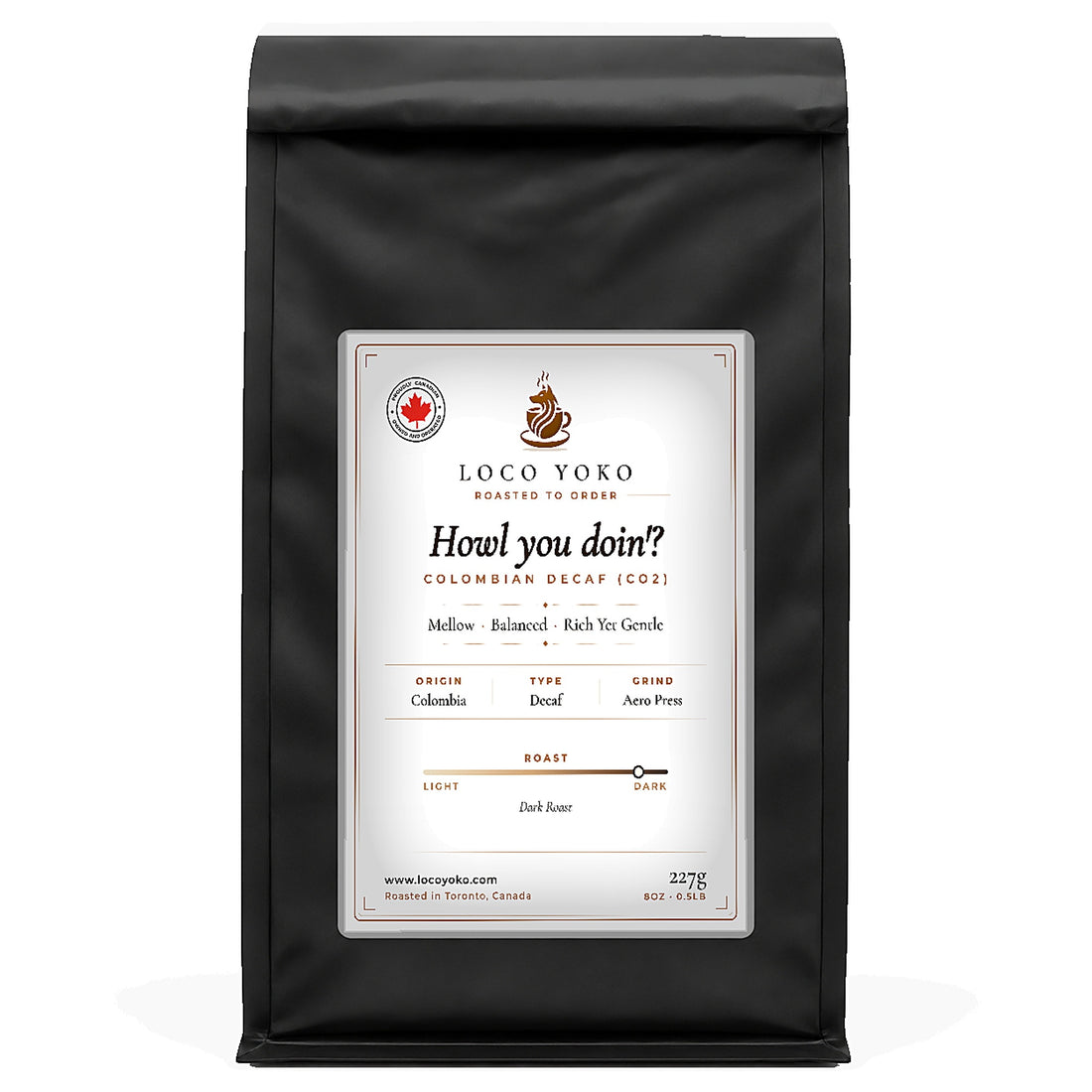


Howl you doin'? - Colombian Decaf (CO2)
Roasted & Packed in Canada | Brought to you by LocoYoko Coffee Whether you're winding down or easing into your day, Howl You Doin’? is your laid-back, tail-wagging companion. Made from premium Colombian Arabica beans, this roast delivers all the rich flavour you love — with only a...
 2026 Canadian Choice Award
Proud winner
2026 Canadian Choice Award
Proud winner
Cupping notes: Mellow · Balanced · Rich yet gentle. Single-origin from Colombia. Roasted to order and stamped with its roast date — best enjoyed within 4 weeks.
We roast and ship Monday–Friday, usually within 24 hours. Free shipping Canada-wide on orders over $50; flat $6 under. Our 30-day happiness guarantee means we'll make it right.
Pour-over (V60): 1:16 ratio, 22 g coffee to 350 g water at 94 °C, ~2:45 total. Prefer filter or French press? Pick your grind above and we'll dial it in.
The spec sheet.
Every bag is stamped with the day it was roasted. If it's older than 30 days when it reaches you, we'll replace it free.
What Canadians say.
Write a review
I've reordered three times now. Smooth, balanced and the coffee I reach for every single morning.
Honestly didn't expect to taste this much difference. The mellow is lovely and it arrived ridiculously quick.
Genuinely fresh and full of character — the mellow note comes through beautifully. Easily my favourite coffee right now.
Pairs well with.
A Colombian Decaf That Still Tastes Like Coffee
Most decaf gets ordered out of obligation, not desire. Someone at the table can't have caffeine after 2pm, so the pot gets made anyway, and it tastes like the memory of coffee rather than the thing itself. Howl You Doin'? was built to break that pattern. It's a single origin colombian decaf, processed with CO2, roasted the same way we roast our caffeinated lots, and it holds onto the body and sweetness that Colombian beans are known for instead of trading them away for a caffeine-free label.
The green coffee comes from the same growing regions that feed the rest of our Colombian and decaf lineup, mostly mid-to-high altitude farms in Huila and Tolima where the diurnal temperature swing (hot days, cool nights) slows down cherry ripening and builds sugar in the bean. That's the foundation of good colombian decaf coffee: you can't manufacture that flavor in the roaster, you can only preserve what's already there. Our job with Howl You Doin'? was to decaffeinate it without stripping that out, then roast it to show it off.
Why CO2 Processing, Specifically
There are three decaffeination methods you'll run into as a coffee drinker: Swiss Water, solvent-based (methylene chloride or ethyl acetate), and CO2. We chose the co2 process decaf coffee method for this lot because it's gentle on flavor while still being thorough on caffeine removal. Green beans are soaked and pressurized with supercritical carbon dioxide, which binds to caffeine molecules and pulls them out without touching much else in the bean's chemistry. No chemical solvents ever touch the coffee, and unlike some solvent methods, CO2 doesn't tend to flatten the sweetness or leave a papery aftertaste behind.
People often ask about swiss water vs co2 decaf and which is "better." Honestly, both are legitimate, largely chemical-free approaches (Swiss Water uses only water and osmosis, no CO2 or solvents at all), and we carry this same origin both ways for exactly that reason — if you'd rather try the Swiss Water version, that's Yoko's Special Decaf, a Colombian decaf green coffee processed with Swiss Water instead of CO2. The two methods land slightly differently in the cup: CO2 tends to preserve a touch more of the roast's natural acidity and brightness, while Swiss Water often reads a hair rounder and softer. If you've tried decaf before and found it thin or flat, the processing method is usually the reason, not the origin.
Flavor Profile: Mellow, Balanced, Rich Yet Gentle
In the cup, Howl You Doin'? is exactly what its tasting notes promise: mellow, balanced, rich yet gentle. There's a soft nuttiness up front, a little brown sugar sweetness through the middle, and a clean, short finish with none of the bitter, ashy edge that gives decaf its bad reputation. This is a mellow balanced decaf coffee in the true sense — nothing about it fights for attention, which is exactly the point for an evening or late-afternoon cup.
If you're the kind of drinker who wants decaf coffee that tastes like regular coffee rather than something adjacent to it, this is the lot to reach for. The body is medium-full, closer to what you'd expect from a washed Colombian than the thin, watery character a lot of decaf falls into. We'd put it up against our regular-caffeine Colombian offerings for depth of flavor; the only thing missing is the caffeine.
Who This Coffee Is For
- Anyone managing caffeine intake for health reasons who still wants a full-flavored daily cup, not a compromise.
- Evening and after-dinner drinkers — this is genuinely one of the best decaf coffee for evening use in our lineup, because the low acidity and smooth finish won't sit heavy before bed.
- People looking for low acid decaf coffee canada shoppers regularly search for; the CO2 process combined with our roast profile keeps acidity gentle without going flat.
- Guests and mixed households where some drink caffeinated and some don't — brew this alongside a regular pot and nobody will feel like they got the consolation prize.
- Anyone who's sworn off decaf because of bad experiences with over-processed, stale, or under-roasted beans from bigger commercial roasters.
Roast Level and Why It Matters for Decaf
We roast Howl You Doin'? to a medium roast, slightly fuller than a classic filter roast but well short of the oily, scorched-sugar territory of a dark roast. Decaffeinated beans behave differently in the roaster than green, caffeinated beans — they're more porous after processing and can scorch faster if you push them too dark, which is exactly how so much commercial decaf ends up tasting burnt and one-dimensional. Staying medium lets the Colombian sweetness and body come through instead of getting roasted away, which is a big part of why this reads as smooth decaf coffee beans rather than something harsh.
Every bag is roasted to order here in Toronto, and we recommend a 24-72 hour rest period after the roast date before you brew. That rest lets residual CO2 from roasting (a normal part of roasting any bean, separate from the decaf process itself) escape the beans, which improves both grind consistency and extraction. Buy it fresh, let it rest, then brew.
Grind and Brew Guidance
We sell Howl You Doin'? as whole bean decaf coffee canada customers can grind fresh at home, and we'd encourage grinding just before brewing if you have a burr grinder — pre-ground decaf loses aromatics fast because of that extra porosity from processing.
- Drip / auto-drip: medium grind, similar to coarse sand. This is the most forgiving method for this coffee and lets the balanced profile shine without fuss.
- Pour-over (V60, Chemex, Kalita): medium-fine grind, water just off boil (around 94-96°C). A 1:16 coffee-to-water ratio gives a clean cup that shows off the brown-sugar sweetness.
- French press: coarse grind, 4-minute steep. The fuller body of this Colombian decaf holds up well to immersion brewing.
- Espresso: fine grind if your machine can pull it — decaf espresso benefits from a slightly shorter, more concentrated shot since there's less caffeine-driven crema structure to work with. This one still pulls a respectable shot given the medium roast.
- Cold brew: coarse grind, 12-16 hour steep. Because there's little bitterness to mask, cold brew comes out smooth rather than needing dilution to be drinkable.
Water temperature and grind size matter more with decaf than with regular coffee, since processing changes the bean's density slightly. If your decaf has ever tasted sour or weak, try grinding a touch finer and brewing a bit hotter before writing off decaf altogether.
One thing worth knowing if you're new to brewing decaf specifically: because the CO2 process opens up the bean's cell structure a little more than untreated green coffee, decaf can extract slightly faster than a regular-caffeine bean at the same grind setting. If your usual pour-over recipe tastes sharper or thinner than you'd expect on this bag, that's normal — dial the grind slightly coarser or shave a few seconds off your brew time rather than assuming something's wrong with the coffee. Most people find they only need to make that adjustment once, then it becomes second nature.
Storage matters too, maybe more than with caffeinated beans. Keep the bag sealed, away from direct light and heat, and resist the urge to refrigerate or freeze it unless you're storing more than a month's supply — temperature swings from a fridge introduce condensation that dulls flavor faster than room-temperature storage in a dark cupboard. A simple opaque, airtight container does more for freshness than any freezer ever will for a bag you're working through in the ordinary two-to-three-week window.
A Note on Where This Fits in Your Routine
We hear from a lot of customers that decaf ends up being an afternoon-and-evening coffee rather than a first-cup-of-the-day coffee, and Howl You Doin'? was roasted with that use case front of mind. It's mellow enough not to disrupt sleep, balanced enough not to feel like a downgrade from your morning brew, and full-bodied enough that it doesn't feel like an afterthought. Some customers keep a bag of this alongside a caffeinated Colombian specifically so they can switch after 2 or 3pm without switching flavor profiles entirely — the tasting notes carry over closely enough that the transition barely registers.
It also travels well for anyone who's cut back on caffeine but still wants the ritual of good coffee when hosting. Pour a round of this alongside a caffeinated pot at a dinner party and most guests genuinely can't tell which is which until you mention it — which is really the whole goal of a well-made decaf: not to apologize for what it lacks, but to stand on its own as a cup worth drinking.
How It Compares to the Rest of Our Colombian Lineup
If you're curious about the raw material before roasting or decaffeination, our Green Machine green coffee is the same Colombian origin in its unroasted, fully-caffeinated state — useful if you roast at home or just want to see where this all starts. For home roasters who want the decaf version in green form, Loco-licious is our Colombian decaf green coffee, also CO2-processed, so you can roast it yourself to whatever level you prefer. And as mentioned, Yoko's Special Decaf covers the same origin through the Swiss Water route if you want to compare processing methods side by side.
Across our broader coffee selection, Howl You Doin'? sits among our most approachable, lowest-fuss options — it's hard to brew badly and forgiving of grind imprecision, while still rewarding more careful pour-over technique if that's your thing.
Sourcing, Freshness, and What You're Actually Buying
We're one of the roasters offering decaf coffee beans canada wide with free shipping over $50, and like the rest of our lineup, this is roasted to order rather than pulled from a warehouse shelf — you're not buying decaf that's been sitting in a bag for months before it even reaches you. For a bean that's already a bit more delicate post-processing, that freshness matters more than usual. We'd rather you order what you'll drink in two to three weeks and reorder than stockpile decaf that slowly loses its edge in the pantry.
If you've been hesitant to buy decaf coffee online canada wide because of past disappointments — thin body, burnt flavor, that flat "why bother" quality — this is the bag we'd point you to first. It's not a watered-down version of our regular menu; it's a full-flavored colombian coffee no caffeine option that happens to also be great any time of day you want the ritual without the buzz. And for anyone still comparing decaf methods on co2 decaf coffee beans generally versus other approaches, this lot is a solid benchmark for what CO2 processing can do when the underlying green coffee is this good to start with.
FAQ
Does CO2-processed decaf really taste different from Swiss Water decaf?
Yes, though the difference is subtle rather than dramatic. CO2 processing tends to preserve slightly more of the bean's natural acidity and brightness, since supercritical carbon dioxide is very selective about what it removes. Swiss Water, which uses only water, temperature, and time, often produces a marginally rounder, softer cup. Both are considered clean, largely solvent-free methods, and the origin coffee matters just as much as the process — that's why we offer this same Colombian lot both ways.
Is CO2 decaf coffee actually caffeine-free?
No decaf is 100% caffeine-free, including CO2-processed coffee, but the process typically removes 97-99.9% of the original caffeine content, which is the same standard used across commercial decaffeination methods. For almost everyone managing caffeine sensitivity, that residual amount is negligible, though if you're fully caffeine-restricted for medical reasons, it's worth checking with your doctor about trace amounts in any decaf.
Why does most decaf coffee taste flat or bitter?
Two culprits, usually. First, some decaffeination methods, particularly aggressive solvent processes done poorly, or over-processed beans, strip out flavor compounds along with the caffeine. Second, and more commonly, roasters push decaf too dark to mask any flavor loss, which just adds bitterness on top of the problem instead of solving it. We roast this lot to a medium roast specifically to avoid that trap, which is a big part of why people describe this as decaf coffee no bitterness compared to what they're used to.
What's the best grind size for this coffee if I only have one grinder setting?
If you have to pick one setting, go medium — the same grind you'd use for a standard drip machine. It's the most forgiving choice across brew methods and will get you a balanced cup whether you're using a basic coffee maker or an ad hoc pour-over. From there, go finer for espresso or coarser for French press and cold brew as you experiment.
How is this different from your green (unroasted) Colombian decaf?
This product is roasted and ready to brew. Our green Colombian decaf, Loco-licious, is the same CO2-processed origin sold unroasted, meant for people who roast their own coffee at home and want control over the final roast level. If you don't have a home roaster, this roasted version is the one you want.
Can I use this for espresso, or is it strictly a filter coffee?
It works for both. The medium roast and Colombian body give it enough structure to pull a solid espresso shot, though like most decaf it produces a bit less crema than caffeinated beans due to differences in bean density and gas retention. For straight filter or pour-over brewing, it performs excellently and is arguably where this coffee shows its best side.
Frequently asked questions
The essentials about this coffee. Still curious about something?
Ask us anything