
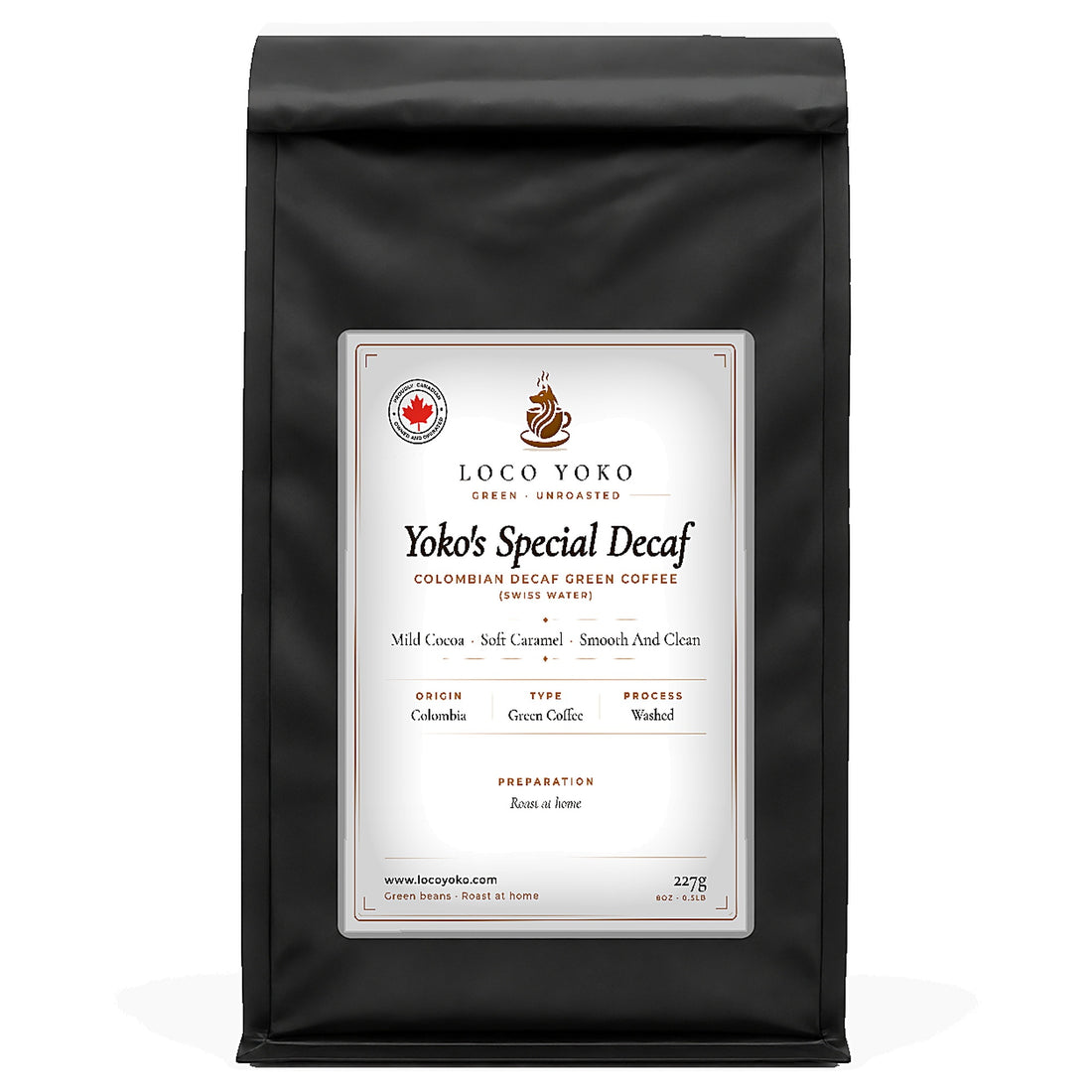


Yoko's Special Decaf - Colombian Decaf Green Coffee (Swiss Water)
Green Coffee Beans | Roasted at Home by You | Brought to You by LocoYoko Coffee For the moments that call for calm, not caffeine — Yoko’s Special Decaf brings you Colombian green coffee beans decaffeinated using the clean, chemical-free Swiss Water® Process. These 100% Arabica beans deliver...
 2026 Canadian Choice Award
Proud winner
2026 Canadian Choice Award
Proud winner
Cupping notes: Mild cocoa · Soft caramel · Smooth and clean. Single-origin from Colombia. Roasted to order and stamped with its roast date — best enjoyed within 4 weeks.
We roast and ship Monday–Friday, usually within 24 hours. Free shipping Canada-wide on orders over $50; flat $6 under. Our 30-day happiness guarantee means we'll make it right.
Pour-over (V60): 1:16 ratio, 22 g coffee to 350 g water at 94 °C, ~2:45 total. Prefer filter or French press? Pick your grind above and we'll dial it in.
The spec sheet.
Every bag is stamped with the day it was roasted. If it's older than 30 days when it reaches you, we'll replace it free.
What Canadians say.
Write a review
Showed up fast and tasted even better than I hoped. That mild cocoa finish keeps me coming back.
Switched from the grocery-store stuff and never looked back. Loved discovering Colombia. Fresh every time.
Gorgeous cup. Mild cocoa on the nose, smooth all the way down. Feels premium without the airs.
Pairs well with.
Colombian Decaf, the Swiss Water Way
Yoko's Special Decaf is our answer to a question we hear all the time at the roastery: can decaf actually taste like coffee? This is a colombian decaf coffee beans selection grown in the same highland regions that produce our regular-caffeine Colombian lots, then decaffeinated using the Swiss Water Process before it ever reaches our roasters in Toronto. No solvents, no methylene chloride, nothing but water, temperature, and time pulling the caffeine out while the sugars, acids, and oils that carry flavor stay put. If you've been let down by thin, papery decaf in the past, this is the lot we'd hand you to change your mind.
We source this as colombian green coffee beans from cooperative-linked farms in the Colombian highlands, at the altitudes where the cherries ripen slowly and develop the sugar concentration that gives Colombian coffee its reputation for balance. The green is shipped to the Swiss Water facility for decaffeination before import, then it lands with us as raw green coffee — coffee raw beans that are ready to roast to order. Because it arrives green rather than pre-roasted, we control the roast curve start to finish, which matters more with decaf than with regular coffee — decaffeinated beans behave differently in the roaster and it's easy to roast them flat if you're not paying attention.
What the Swiss Water Process Actually Does
The Swiss Water Process is a chemical free decaf coffee method developed in, unsurprisingly, Switzerland, and now run at a dedicated facility in British Columbia. Green coffee is soaked in a solution of water fully saturated with the coffee's own soluble compounds — sugars, acids, flavor precursors — everything except caffeine. Because that solution is already saturated with everything but caffeine, when the beans go in, only caffeine has anywhere to migrate to. It diffuses out of the bean and gets filtered out of the solution using activated carbon, and the process repeats until the beans hit 99.9% caffeine-free.
That's the whole trick of swiss water process decaf: no solvent ever touches the bean directly, and the flavor compounds that give a coffee its character are preserved rather than stripped alongside the caffeine. Compare that to solvent-based decaffeination, which uses ethyl acetate or methylene chloride applied straight to the bean, and which tends to flatten cup character even when it's done well. If you want organic swiss water decaf coffee that still tastes like where it came from, this is the process that gets you there.
It's worth understanding why this matters beyond marketing language. Coffee's flavor comes from hundreds of soluble compounds developed during growing, fermentation, and drying at origin — the same compounds responsible for body, sweetness, and acidity in the final cup. Solvent-based decaffeination methods are efficient, but because the solvent has an affinity for more than just caffeine, some of those flavor compounds get pulled out along with it, which is a big part of why so much decaf on grocery shelves tastes muted or one-dimensional. The Swiss Water facility solves this with plain osmosis and a pre-saturated solution rather than chemistry, which is slower and more expensive but leaves far more of the bean's original character intact by the time it reaches our roasters.
Flavor Profile: Mild Cocoa, Soft Caramel, Clean Finish
In the cup, Yoko's Special Decaf leans gentle and rounded rather than sharp or bright. You'll get mild cocoa up front, a soft caramel sweetness through the middle, and a finish that's smooth and clean without any of the bitterness or dryness that gives decaf a bad name. This is decaf coffee with chocolate caramel notes in the most literal sense — it's not a marketing description, it's what actually happens when Colombian Supremo-grade green goes through Swiss Water processing and gets roasted with a light hand.
If you're chasing smooth decaf coffee no acidity can sometimes tip into, and looking for something with real body and a bit of sweetness instead of a flat, watered-down cup, this lot delivers. It's also fair to call it low acid decaf coffee beans territory — the Swiss Water method combined with a medium roast keeps the natural acidity of the Colombian bean gentle rather than sharp, so it sits easy even later in the day or on a sensitive stomach. We'd put this up against any best decaf coffee beans list without hesitation; it's the lot we recommend most often when someone asks for a decaf that doesn't taste like an apology.
What makes the cocoa and caramel notes so consistent is the combination of origin and roast level rather than any single factor on its own. Colombian Supremo beans already carry natural sugar development from slow ripening at altitude, and a medium roast is where those sugars caramelize without tipping into the darker, ashier notes you'd get from pushing the roast further. Because decaf beans are more porous and roast faster than regular green, we watch this batch closely through the back half of the roast to stop right at the point where the sweetness peaks, rather than letting momentum carry it past the target and into something flatter.
Who This Coffee Is For
This is the bag for the afternoon or evening drinker who still wants a proper cup, not a compromise. It's for anyone cutting back on caffeine without wanting to cut back on flavor, for pregnant or nursing customers who ask us constantly for a decent decaf, and for anyone sensitive to caffeine's jittery edge who still loves the ritual of coffee. It also earns a spot in any household that keeps both regular and decaf on hand — pair it with our Yoko's Courage Colombian Espresso for a full-caffeine option from the same growing region, so morning and evening drinkers in the same house are both covered without switching origins.
Home roasters specifically are a big part of who buys this. If you're building out a rotation of decaf green coffee beans for home roasting, Colombian Swiss Water is one of the more forgiving and rewarding greens to start with — it's dense enough to handle a range of roast levels and consistent enough that your results won't vary wildly bag to bag.
We also see this bag picked up by offices and shared kitchens where someone in the group can't or won't drink caffeine after a certain hour but doesn't want to be handed a separate, lesser jar of instant decaf. Brewed side by side with a regular Colombian lot, this one holds its own — nobody at the pot is going to clock it as the "decaf option" unless you tell them.
Roast and Grind Guidance
We roast this to a medium level by default, which is where the cocoa and caramel notes show up most clearly. Push it darker and you'll pick up more roast-driven bitterness that can mask the natural sweetness; pull it lighter and the cup can taste a little green or underdeveloped, since decaf beans already lost some structural integrity in processing and need a slightly gentler, longer roast curve to develop fully. If you buy this green for home roasting, expect it to color up faster than a non-decaf lot — decaffeinated beans are more porous and conduct heat differently, so watch your first crack timing rather than relying purely on time or temperature targets from your usual routine.
- Drip or pour-over: medium grind, similar to sea salt
- French press: coarse grind, steeped 4 minutes
- Espresso: fine grind, dialed slightly finer than you'd expect since decaf pucks can channel more easily
- Cold brew: extra coarse, steeped 12-18 hours for a naturally sweet, low-acid glass
As with all our roasted coffee, give the bag a 24-72 hour rest after the roast date before brewing. Decaf especially benefits from this window — the beans are still off-gassing CO2 and the flavor settles and rounds out noticeably by day two or three.
Brewing Tips for a Better Decaf Cup
The biggest mistake people make with decaf is treating it exactly like regular coffee and being disappointed when it tastes thinner. Decaf beans are slightly less dense after processing, so we recommend nudging your dose up slightly from your usual ratio — try 1:15 instead of 1:16 if you're using a scale — to compensate. Water temperature matters too: aim for the lower end of the standard range, around 195-200°F, since decaf can extract bitterness a little faster than regular coffee at the same temperature.
If you're used to buying decaf coffee canada wide in grocery store bags that have been sitting on a shelf for months, the difference roasted-to-order decaf makes is dramatic — stale decaf loses whatever flavor complexity it had even faster than stale regular coffee, so freshness matters more here, not less.
Grind size and brew time deserve a second look too, especially if you've switched over from a regular-caffeine routine. Because decaf beans lose a bit of density during processing, they can over-extract slightly faster than you're used to, which is what produces the thin, bitter cup people sometimes blame on decaf itself rather than on dial-in. If your pour-over is coming out sharp or hollow, try coarsening the grind half a step and shaving 15-20 seconds off your total brew time before you touch the dose — it's usually a grind-and-timing fix, not a bean problem. The same logic applies to drip machines: if yours has a strength or bloom setting, decaf is one of the few cases where we'd actually recommend using it, since it slows the flow rate just enough to compensate for that faster extraction. Filter choice matters here too. A paper filter gives you the cleanest possible cup and lets the cocoa and caramel notes come through without any muddiness, while a metal mesh filter or French press adds body and a heavier mouthfeel at the cost of a bit of clarity. Neither is wrong — it depends on whether you want this coffee to taste light and precise or rounder and more full-bodied in the cup.
How It Compares to Our Other Colombian Lots
We carry a few different expressions of Colombian coffee, and it's worth knowing how they stack up against each other. Our Green Machine Colombian Green Coffee is the same origin in fully caffeinated, unroasted form — the green coffee bean version of a regular Colombian, ideal if you want to roast your own non-decaf batch from scratch. If you want decaf but prefer to roast it yourself rather than buying it pre-roasted, Loco-licious Colombian Decaf Green Coffee is our raw, unroasted Swiss Water decaf green — essentially the DIY version of this same bag, and a great pick if you're building a collection of green coffee beans canada home roaster setups already stock.
For the caffeinated, espresso-focused side of the same region, our Yoko's Courage Colombian Espresso is roasted darker and blended for pulling shots rather than drip brewing. You can browse the full lineup, decaf and regular, on our Colombian coffee collection page, or see how this bag fits into our wider lineup on the main coffee collection, where we list roast levels and origins side by side for easy comparison.
Customers sometimes ask which of the three Colombian bags to start with if they're new to the origin. Our honest answer: if you drink caffeine without issue and want the clearest read on what Colombian coffee tastes like unfiltered by processing differences, start with Green Machine roasted at home or ask us to roast it for you. If caffeine is the whole reason you're here, Yoko's Special Decaf is the easier entry point since it's already dialed in and ready to brew. Home roasters who want full control over both should grab a bag of each and compare them side by side — the differences in body and sweetness between the decaf and regular versions of the same origin are genuinely instructive.
Sourcing and Grade
This lot is graded Colombian Supremo decaf before processing, meaning the green beans meet the size and defect standards for Colombia's top export grade — large, dense beans with minimal imperfections, which generally means more even roasting and a cleaner cup. Supremo grade isn't a flavor guarantee on its own, but it correlates strongly with consistency, which matters even more in decaf where processing has already changed the bean's structure once before it gets to us.
If you're looking to buy decaf coffee beans online canada wide and want a straightforward, honest option, roasted to order in Toronto and shipped free across Canada on orders over $50, this is one of our most requested bags for exactly that reason — real origin, real process, no shortcuts. We roast in small batches and ship promptly after the rest period, so what arrives at your door is close to peak freshness rather than something that's been sitting in a warehouse for weeks before it even reaches a shelf.
FAQ
Is Swiss Water decaf really chemical-free?
Yes. The Swiss Water Process uses only water, temperature, and time — no solvents like methylene chloride or ethyl acetate ever touch the bean. Caffeine is drawn out through an osmosis-style process into a water solution that's already saturated with the coffee's other soluble compounds, then filtered out using activated carbon.
Does decaf coffee still have any caffeine?
A small trace amount remains — Swiss Water Process coffee is certified 99.9% caffeine-free, which is the industry standard for decaf. It's not zero, but it's low enough that most people sensitive to caffeine notice a real difference switching to it.
Why does decaf sometimes taste flat or bitter?
Decaffeination changes the bean's cell structure, which can make it more prone to uneven roasting if the roaster doesn't adjust the curve. Solvent-processed decaf also tends to lose more of its natural flavor compounds during processing. Swiss Water processing preserves more of those compounds, and roasting it slightly gentler than a regular-caffeine bean helps avoid the flat, bitter cup people associate with decaf.
Can I use this as green coffee for home roasting?
This particular listing is roasted, but we also carry it as raw green under the Loco-licious name if you'd rather roast it yourself. It's a good choice for home roasting since it's dense enough to handle a range of roast levels, though it does color up faster in the roaster than non-decaf green, so keep an eye on your first crack timing.
How should I store this coffee to keep it fresh?
Keep it in an airtight container away from light, heat, and moisture, ideally in the bag it shipped in with the valve intact. Avoid the fridge or freezer for coffee you'll drink within a few weeks — condensation does more harm than good. Buy what you'll use in two to three weeks for the best cup.
What's the difference between this and your other Colombian decaf?
Yoko's Special Decaf is roasted and ready to brew, medium roast, cocoa and caramel forward. Loco-licious Colombian Decaf Green Coffee is the same Swiss Water-processed origin sold raw and unroasted, for home roasters who want to control the roast curve themselves. Both come from the same Colombian growing regions and the same decaffeination process.
Frequently asked questions
The essentials about this coffee. Still curious about something?
Ask us anything