Swiss Water Decaf: How It Works & Why It Tastes Better

Decaf carries a reputation for tasting flat, and for a long time that reputation was earned. Older decaffeination methods relied on chemical solvents that stripped out caffeine along with a good share of the flavour compounds that make coffee taste like coffee. The Swiss Water Process takes a different approach: no solvents at all, just water, temperature, time, and carbon filtration. It's slower and more expensive than solvent-based methods, which is part of why it isn't the industry default, but it's also why coffee decaffeinated this way tends to hold onto more of its original character.
How Is Coffee Decaffeinated? The Conventional Method, for Contrast
Most decaf on the market is made using a chemical solvent — commonly methylene chloride or ethyl acetate — to strip caffeine from green, unroasted beans, either by direct contact or by rinsing beans that have already been soaked. These methods are effective at removing caffeine and are used at scale because they're fast and relatively cheap. The problem is that the solvent doesn't only target caffeine. It also carries away some of the oils and compounds that give coffee its flavour and aroma, which is a big part of why conventional decaf can taste muted next to its caffeinated counterpart.
Inside the Swiss Water Process
The process starts with a batch of green coffee soaked in hot water. Because both caffeine and flavour compounds are soluble, this soak pulls both out of the beans and into the water, taking a share of the beans' character with it. That water — now carrying dissolved caffeine along with dissolved flavour — is passed through an activated carbon filter. The filter is calibrated so that caffeine molecules are trapped by the carbon while the larger flavour and aroma compounds pass through it. What's left is water that's saturated with the taste of coffee but stripped of caffeine, generally referred to in the industry as green coffee extract.
That flavour-charged water is then used to soak a fresh batch of green beans — the beans that actually end up in the bag. Because the water is already saturated with the same soluble flavour compounds the beans contain, there's no concentration gradient left to pull those compounds out, so they stay in the bean. Caffeine is a different story: it's still present in the beans and largely absent from the water, so it moves out of the beans and into the water along a straightforward concentration gradient — the same basic diffusion principle behind a tea bag steeping in a cup. The beans lose caffeine without losing much of what makes them taste like themselves, and no solvent ever touches the beans directly at any point.
Despite the name, the Swiss Water Process is Canadian. The company that owns and operates the certified process runs its facility out of British Columbia, and it's one of the few decaffeination methods in the world with its own certification mark specifically because it verifies both the absence of solvents and the caffeine-removal threshold. Roasters who want a chemical-free decaf send green beans to a facility running this exact process rather than decaffeinating in-house, since the equipment and the calibrated carbon filtration aren't something an individual roastery typically builds on its own.
Is Decaf Coffee Caffeine-Free?
It's worth being precise here: decaf coffee, including Swiss Water decaf, is not caffeine-free. The process is certified to remove the large majority of caffeine from the beans — Swiss Water's own certification puts the figure at 99.9% — but a small residual amount remains in the finished, roasted coffee. If you're avoiding caffeine entirely for a medical reason, that residual amount is worth knowing rather than assuming "decaf" means zero. For most people who are cutting back, drinking later in the day, or simply prefer a lighter cup, that trace amount isn't a meaningful concern.
Does Decaf Taste Different?
Does decaf taste different from regular coffee? Usually, yes, but often less than people expect. Because no chemical solvent ever contacts the beans, and because the flavour-charged water is specifically designed not to strip out soluble flavour compounds, Swiss Water decaf generally holds onto more of a coffee's original character than solvent-processed decaf does. That said, "closer to regular" is a fairer description than "identical." Soaking green beans in water and then drying them again changes the bean's structure — it becomes more porous — and that affects how the bean roasts and how it later extracts once ground and brewed. Roasters often adjust their approach specifically for decaf, because it behaves a little differently under heat than the same beans would un-decaffeinated. The result is coffee that's recognizably close to its origin character, but a careful taster can usually still tell a decaf apart from its caffeinated counterpart from the same lot.
That structural change also affects roasting. Beans that have been soaked and dried are more porous than they were before, which means they tend to roast faster and can scorch more easily than the same beans would un-decaffeinated. Roasters typically shorten roast times and watch decaf batches more closely to avoid pushing them too dark, which would flatten flavour in a different way than the decaffeination process itself. Good decaf isn't just about the process the green beans went through — it's also about a roaster paying attention once those beans hit the roaster.
Who Should Drink Decaf?
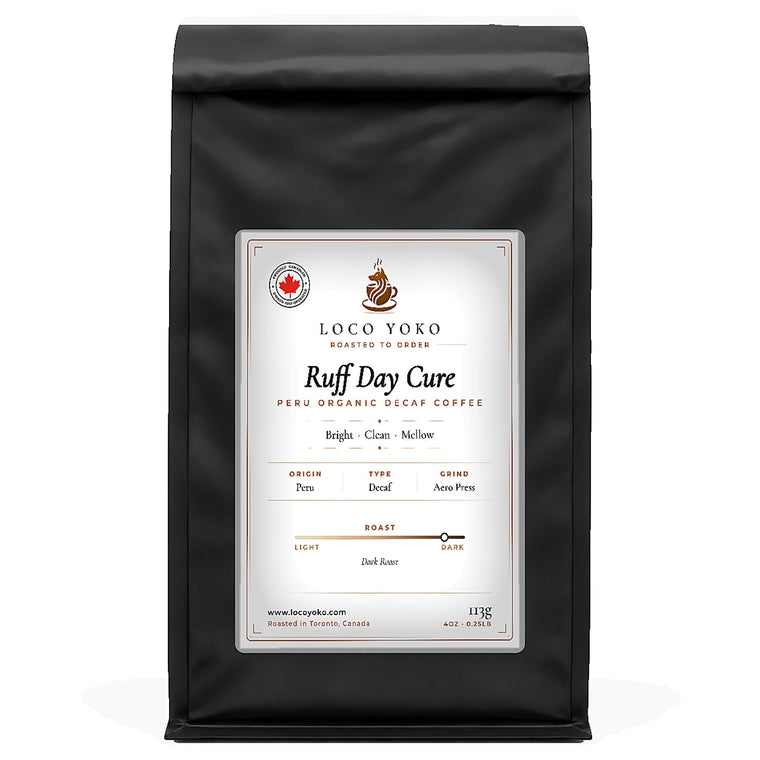
Who should drink decaf? It isn't just a fallback for people who can't have caffeine. Evening drinkers who still want the ritual of a cup after dinner, people who are sensitive to caffeine, expecting parents who are cutting back, and anyone managing their intake for sleep or other reasons all have good cause to reach for it. At LocoYoko we roast to order out of Toronto, and a Swiss Water-processed single origin gives you a genuine coffee experience at almost any hour, without the trade-off older decaf methods used to force on you.
It's also worth remembering that decaf is still coffee grown, harvested, and processed the same way as any other lot — the decaffeination step happens afterward, on green beans, before roasting. A Swiss Water decaf can come from any origin capable of producing good coffee in the first place; the process itself doesn't add or require a particular growing region. What it does add is a step between farm and roaster, which is part of why decaf tends to cost a little more than the same coffee would caffeinated. That cost buys a method that respects the bean rather than working against it, which is the whole point of choosing it over a solvent-based alternative.