
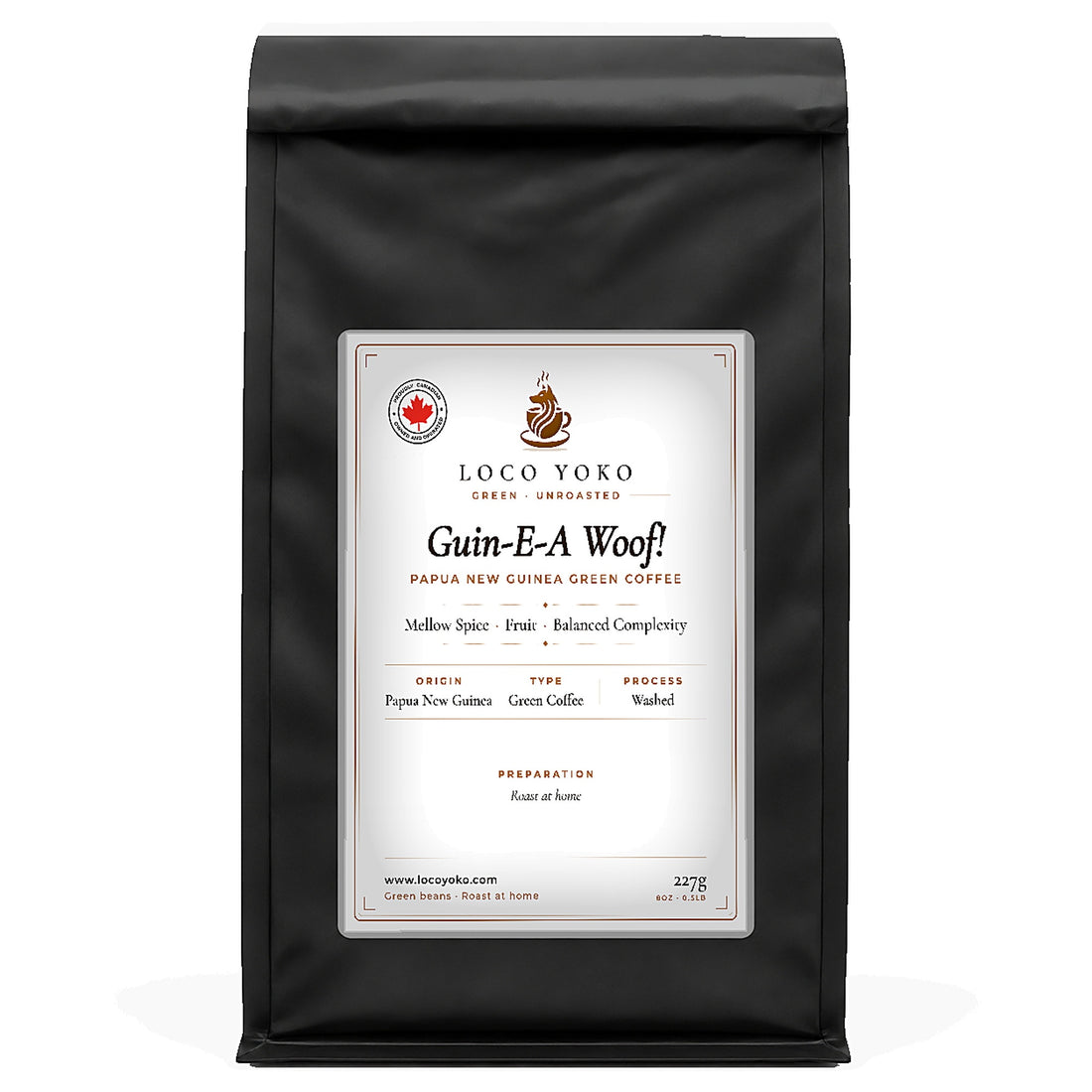


Guin-E-A Woof! - Papua New Guinea Green Coffee
Green Coffee Beans | Roasted at Home by You | Brought to You by LocoYoko Coffee For curious roasters with a nose for nuance, Guin-E-A Woof! is a green coffee that rewards patience and precision — just like earning the trust of a loyal companion. These unroasted Arabica...
 2026 Canadian Choice Award
Proud winner
2026 Canadian Choice Award
Proud winner
Cupping notes: Mellow spice · Fruit · Balanced complexity. Single-origin from Papua New Guinea. Roasted to order and stamped with its roast date — best enjoyed within 4 weeks.
We roast and ship Monday–Friday, usually within 24 hours. Free shipping Canada-wide on orders over $50; flat $6 under. Our 30-day happiness guarantee means we'll make it right.
Pour-over (V60): 1:16 ratio, 22 g coffee to 350 g water at 94 °C, ~2:45 total. Prefer filter or French press? Pick your grind above and we'll dial it in.
The spec sheet.
Every bag is stamped with the day it was roasted. If it's older than 30 days when it reaches you, we'll replace it free.
What Canadians say.
Write a review
Bold without being harsh — exactly my kind of coffee. The subscription just shows up and I'm thrilled.
Showed up fast and tasted even better than I hoped. That mellow spice finish keeps me coming back.
Switched from the grocery-store stuff and never looked back. Loved discovering Papua New Guinea. Fresh every time.
Pairs well with.
What Guin-E-A Woof! Actually Is
Guin-E-A Woof! is our unroasted Papua New Guinea Highlands lot, sold raw so you can roast it yourself, on your own schedule, in your own kitchen. This is not a roasted bag with a fun name slapped on it — it's genuine papua new guinea green coffee beans, still dense, still slightly grassy-smelling, still full of the moisture and structure that a roaster needs to work with. If you've never bought unroasted green coffee beans canada-wide before, this is a solid place to start: PNG lots are forgiving to roast, expressive in the cup, and distinct enough that you'll actually notice what your roast decisions are doing to the flavor.
The coffee comes from smallholder farms scattered across the Eastern Highlands and Western Highlands provinces, at elevations that typically run 1,500 to 1,900 meters. Most PNG coffee is still grown on small family plots of a few hundred trees rather than large estates, then wet-processed at local washing stations — pulped, fermented for 24 to 48 hours depending on ambient temperature, washed, and dried on raised beds or patios. That washed process is a big part of why this lot tastes the way it does: clean, structured, without the wilder fermentation notes you sometimes get from natural-processed lots elsewhere.
Botanically, it's Typica and Arusha-descended Arabica, part of a lineage that traces back to Jamaican Blue Mountain stock brought to the territory decades ago. If you're shopping specifically for papua new guinea arabica green coffee, that heritage matters — it's part of why these beans tend to roast up round and sweet rather than sharp or acidic. We source this particular lot as one of the more reliable papua new guinea coffee beans canada home roasters can get their hands on in useful volume, since a lot of small-batch PNG coming into the country never makes it past specialty cafes and roasteries buying whole containers.
Flavor Profile: Mellow Spice, Fruit, Balanced Complexity
Once roasted, this lot lands squarely in the profile printed on the label — mellow spice, soft fruit, and a complexity that stays balanced rather than showing off any one note. It's a textbook example of the green coffee beans fruity spice notes PNG Highlands lots are known for among roasters who buy this origin regularly. Roasted to a city-plus level, expect gentle baking spice (think nutmeg or clove, never sharp cinnamon-candy), a soft stone-fruit sweetness somewhere between apricot and ripe plum, and a body that's syrupy without being heavy. It's not the loud, wine-like acidity you'd get from a washed Kenyan or the bright citrus snap of an Ethiopian natural — PNG is quieter and rounder, which is exactly what makes it a good everyday cup.
If you want to compare notes side by side, our roasted version of this same origin, Friends Fur-ever! - Papua New Guinea Coffee, is a useful reference cup — same beans, same farms, roasted by us instead of you. Brewing a bag of that alongside your first home roast is a genuinely good way to calibrate whether you've hit the roast level we're aiming for, or whether you want to push darker or pull back lighter next time.
People searching for papua new guinea coffee tasting notes or a general papua new guinea coffee flavor profile tend to land on descriptions like "earthy" or "herbal" from older classic-era PNG lots. This one skews sweeter and cleaner than that stereotype — a function of more consistent wet-processing at the washing stations we buy from, not a fluke of this particular harvest.
Who This Coffee Is For
This is a great fit for three kinds of buyers. First, home roasters who already own a roasting setup — an air popcorn popper, a stovetop pan, or a proper home roaster like a Behmor or Fresh Roast — and want green coffee beans for home roasters that reward attention without punishing small mistakes. PNG is genuinely one of the easier origins to roast well; it doesn't scorch as easily as very dense, high-grown Central American lots, and it doesn't stall out the way some low-density naturals can.
Second, it's for people newer to home roasting green coffee beans who want a low-risk first bag. If your last roast came out uneven, this origin is a good place to try again — the bean size is fairly consistent, which means more even heat absorption across a batch and fewer scorched or underdeveloped beans mixed in together.
Third, it's for the curious drinker who just wants to taste the difference processing and roast level make. Buy a bag of this alongside a bag from a different growing region in our coffee lineup and roast them both the same way, same day, same machine — you'll taste the origin character much more clearly than you would comparing two bags roasted by two different roasters on two different days.
Roast Guidance
PNG Highlands lots like this one are dense enough to hold together through a full roast cycle but forgiving enough that you have real room to move. Here's what we'd suggest if you're new to it:
- City roast (first crack, minimal development): brighter, more acidic, spice notes read as sharper and more clove-like. Good if you're brewing pour-over and want clarity.
- City-plus (30-60 seconds past first crack): this is our house target for the roasted version of this lot — balanced spice and fruit, syrupy body, sweetness fully developed without tipping into roast-driven bitterness.
- Full city (close to second crack): spice notes deepen toward baking chocolate, fruit becomes more like dried fig than fresh stone fruit, acidity drops further. Good for drip machines or if you like a heavier cup.
We don't recommend pushing this one into second crack and beyond — you'll roast right past what makes it distinctive and end up with a generic dark roast that could be almost any origin. Whatever roast level you land on, give the beans 24 to 72 hours to rest after roasting before you brew. That rest period lets residual CO2 escape the bean structure, which matters even more with home-roasted coffee than with coffee that's been resting in a bag on a shelf — freshly roasted beans straight off the cooling tray will taste flat and sometimes sour if you brew them same-day.
Grind and Brew Recommendations
Once rested, this coffee is versatile across brew methods, though its natural sweetness and moderate acidity make it particularly good for methods that let body come through:
- Pour-over (V60, Chemex, Kalita): medium grind, water just off boil (around 94-96°C), 1:16 ratio. This method shows off the spice and fruit most clearly and keeps the cup lighter.
- French press: coarse grind, 4-minute steep, 1:15 ratio. Full immersion brings out the body and rounds off the spice notes into something closer to baking spice than fresh spice.
- Drip machine: medium grind, standard 1:16-1:17 ratio. A dependable everyday cup, especially at the city-plus or full city roast levels.
- Espresso: fine grind, if you're roasting to full city — the syrupy body holds up well under pressure, though this isn't the boldest choice for espresso if you're used to darker origin blends.
Whichever method you use, grind fresh right before brewing rather than in advance — this matters even more for home-roasted coffee, since you've already put in the work to control the roast; grinding ahead of time throws away a chunk of that aromatic complexity through oxidation.
Green Coffee Storage and Handling
One advantage of buying green over roasted is shelf life. Properly stored — cool, dark, away from humidity, ideally in a breathable bag or a container that isn't fully airtight — green coffee holds up for many months without much flavor loss, unlike roasted coffee, which is best used within a few weeks of roasting. That's part of why raw coffee beans buy online canada shoppers often buy in larger quantities than they would roasted coffee: you're not racing a freshness clock the same way, so it's practical to roast in smaller batches as you need them rather than roasting the whole bag at once.
If you're stocking up on multiple origins to roast through over a few months, keep each one in its own labeled bag — green beans from different origins can look surprisingly similar once they're out of retail packaging, and PNG's bean size and color are close enough to some Central American lots that mixing them up is an easy mistake.
How This Compares to Our Other Papua New Guinea Coffee
We carry this origin in two forms for a reason. If you don't own roasting equipment, or you just want a reliably good cup without the extra step, the roasted Friends Fur-ever! PNG coffee is sourced from the same farms and washing stations and roasted in-house to the city-plus profile described above. If you want control over roast level, or you're building out a home roasting habit and want single origin green coffee beans canada roasters can actually source in useful volume, Guin-E-A Woof! is the one to buy.
Beyond this origin, our full coffee selection spans several growing regions if you want to build a comparison lineup — Ethiopian and Kenyan lots for brighter, more acid-forward cups, Central and South American lots for a more classic balanced profile, and this Papua New Guinea lot if you want something with real spice character that still drinks easy. If PNG turns out to be your favorite, our Papua New Guinea coffee page is where we keep every product we carry from this origin, roasted and green, as availability shifts with harvest season.
Why We Buy Specialty Grade
Not all green coffee sold as "PNG" is created equal. Commercial-grade PNG coffee is bulked across many small farms with little sorting, which flattens out a lot of the character that makes this origin interesting in the first place. We buy specialty grade green coffee beans instead — lots that have been hand-sorted for defects, cupped and scored before purchase, and traceable back to specific washing stations rather than an anonymous regional blend. That grading is why this bag tastes like a distinct, describable coffee rather than a generic "medium roast" filler.
It's also why we're comfortable calling this papua new guinea highlands coffee specifically rather than just "PNG coffee" broadly — highland-grown lots at this elevation range develop more sugar and more structured acidity during the longer growing cycle that cooler, higher-altitude conditions produce, and that shows up directly in the cup as the fruit and spice notes we've described.
Buying Green Coffee Online in Canada
If you're looking to buy green coffee beans online canada-wide, sourcing from a roastery that also roasts for retail — rather than a pure green-bean broker — has a practical advantage: we're already buying this origin in volume for our roasted product line, cupping every new lot before it goes on either shelf, so the green beans we sell you have passed the same quality bar as the coffee we roast and sell under our own name. We're not clearing out beans we wouldn't roast ourselves.
Every order ships from our roastery in Toronto, and like the rest of our lineup, it qualifies for free shipping across Canada on orders over $50 — worth keeping in mind if you're planning to stock up on a few origins at once for a home roasting rotation. If PNG becomes a regular in that rotation, buying buy unroasted coffee beans canada orders in this larger green format is generally the more economical way to keep a steady supply on hand compared to repeatedly buying small roasted bags.
FAQ
Do I need special equipment to roast this at home?
No dedicated machine is strictly required. Many home roasters start with a stovetop pan, a modified popcorn popper, or an oven, and get usable results. That said, a purpose-built home roaster (like a Behmor, Fresh Roast, or drum-style unit) gives you far more control over roast level and evenness, which matters more with a characterful origin like this one than it would with a generic blend.
How long should I rest the beans before brewing?
Plan on 24 to 72 hours minimum after roasting, and closer to the higher end if you roasted darker. Freshly roasted beans are still off-gassing CO2, which shows up in the cup as flatness or an odd sourness. This applies whether you're brewing beans you roasted yourself or coffee we roasted for you, like the Friends Fur-ever! bag — we build that same rest period into our own roasting schedule before we ship.
What roast level brings out the tasting notes best?
City-plus, roughly 30 to 60 seconds past first crack, is the sweet spot for the mellow spice and fruit profile this lot is known for. Lighter roasts sharpen the spice and acidity; pushing toward or past second crack mutes the fruit character and moves everything toward generic roast-driven bitterness.
Is this coffee washed or natural processed?
It's wet-processed (washed) at local stations in the Highlands — pulped, fermented, washed, and dried on raised beds. That processing method is a big part of why the cup comes out clean and structured rather than showing the heavier, more fermented fruit notes typical of natural-processed lots from other origins.
How does this compare to your roasted PNG coffee?
Same farms, same washing stations, same green coffee — the only difference is who does the roasting and when. Our roasted Friends Fur-ever! bag is roasted in-house to our house profile and ready to brew on arrival. This green version gives you the same starting material with full control over roast level and timing.
How should I store green coffee before roasting?
Keep it cool, dark, and away from humidity, ideally in a breathable bag rather than sealed completely airtight. Stored well, green coffee holds its quality for many months, which is why it's practical to buy a larger quantity and roast smaller batches over time rather than roasting everything at once.
Frequently asked questions
The essentials about this coffee. Still curious about something?
Ask us anything