
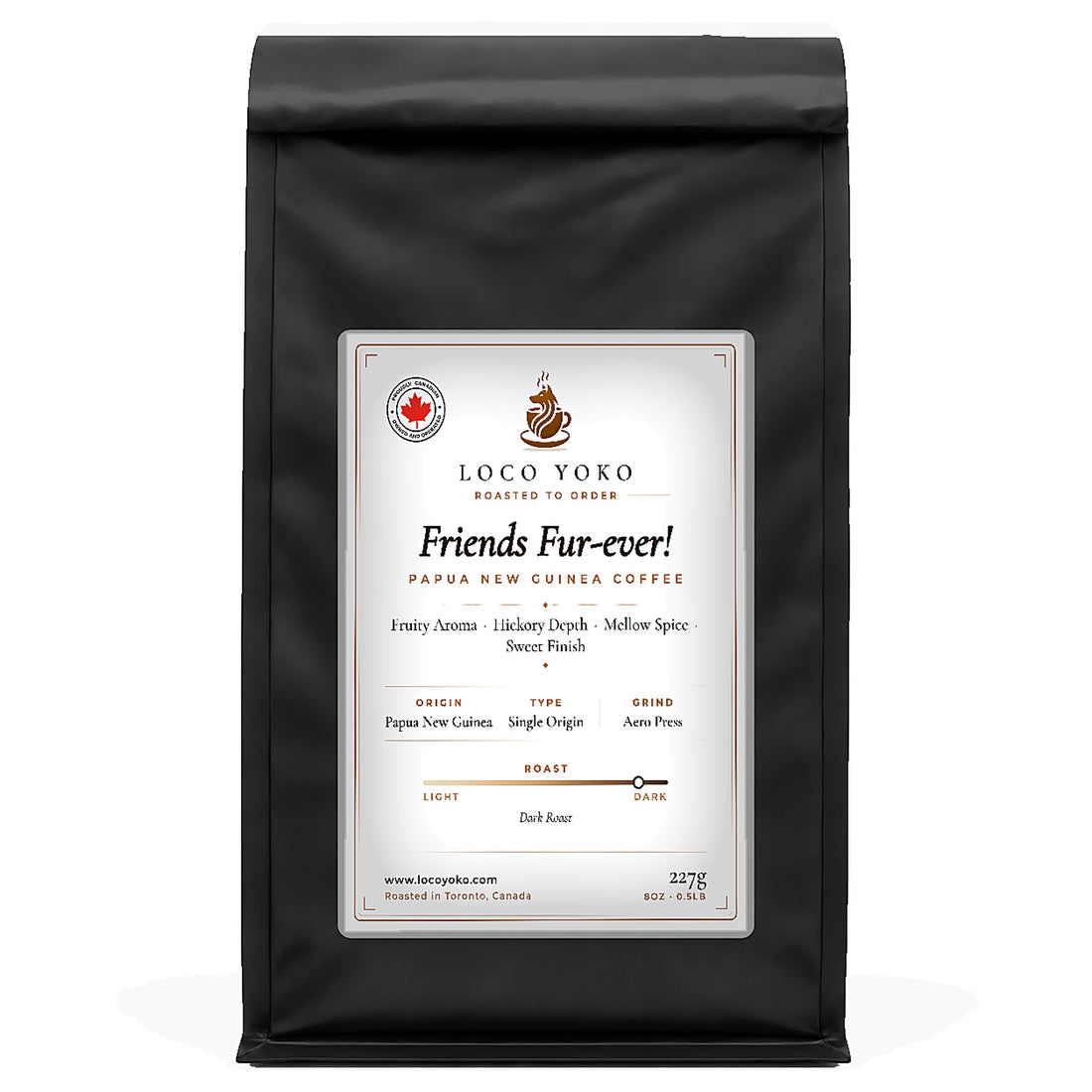


Friends Fur-ever! - Papua New Guinea Coffee
Roasted & Packed in Canada | Brought to you by LocoYoko Coffee Some bonds are built to last — full of depth, warmth, and quiet strength. Friends Fur-ever! is a rich, layered roast made from high-grown Arabica beans from Papua New Guinea’s renowned Sigri estate. With a fruity...
 2026 Canadian Choice Award
Proud winner
2026 Canadian Choice Award
Proud winner
Cupping notes: Fruity aroma · Hickory depth · Mellow spice · Sweet finish. Single-origin from Papua New Guinea. Roasted to order and stamped with its roast date — best enjoyed within 4 weeks.
We roast and ship Monday–Friday, usually within 24 hours. Free shipping Canada-wide on orders over $50; flat $6 under. Our 30-day happiness guarantee means we'll make it right.
Pour-over (V60): 1:16 ratio, 22 g coffee to 350 g water at 94 °C, ~2:45 total. Prefer filter or French press? Pick your grind above and we'll dial it in.
The spec sheet.
Every bag is stamped with the day it was roasted. If it's older than 30 days when it reaches you, we'll replace it free.
What Canadians say.
Write a review
Honestly didn't expect to taste this much difference. The fruity aroma is lovely and it arrived ridiculously quick.
Genuinely fresh and full of character — the fruity aroma note comes through beautifully. Easily my favourite coffee right now.
You can tell this is small-batch — clean, vibrant, and the fruity aroma is spot on. Beautiful packaging too.
Pairs well with.
Woof-tastic Energy
What Makes This Papua New Guinea Coffee Different
Friends Fur-ever! is our single origin Papua New Guinea coffee, sourced from smallholder farms and cooperative-run wet mills scattered across the country's volcanic highlands. If you've never worked with papua new guinea coffee beans before, this is a good place to start: PNG sits geographically and stylistically between the fruit-forward chaos of East Africa and the heavier, earthier profile of Indonesia, but it has its own identity entirely. Most of the country's specialty-grade coffee is grown between 1,300 and 1,900 metres in the Eastern Highlands, Western Highlands, and Jiwaka provinces, where volcanic soil, cool nights, and a long dry harvest season let the cherries ripen slowly. That slow maturation is a big part of why this lot shows the layered, dessert-like cup it does — sweetness has time to build in the cherry before it's ever picked.
We roast this lot to order out of our Toronto roastery, in small batches, which means the beans in your bag were green a few weeks ago rather than sitting in a warehouse for months. Every order of our papua new guinea highlands coffee ships within a day or two of roasting, and like all our coffee we recommend giving it a 24-72 hour rest after the roast date before you brew — degassing evens out, and the flavors you'll read about below come through cleaner once the beans have had a chance to settle.
Flavor Profile: Fruity, Woody, Spiced, Sweet
The papua new guinea coffee tasting notes on this one read: fruity aroma, hickory depth, mellow spice, and a sweet finish — and that order is roughly how the cup unfolds. Crack the bag and the aroma is genuinely fruity, more stone fruit and dried tropical fruit than citrus, closer to what you'd get from a naturally-processed lot than a classic washed African coffee. As it cools in the cup, a smoky, woody hickory character shows up underneath, which is fairly characteristic of PNG coffee generally — locals sometimes call it "jungle" or "earthy," but hickory is the more precise descriptor here, like the smell of aged hardwood rather than campfire ash. Mellow spice follows, somewhere in the cinnamon-and-clove family rather than anything sharp or peppery, and the cup lands on a genuinely smooth sweet finish coffee beans drinkers tend to notice right away — no bitterness lingering on the back end, no sourness creeping in as it cools.
If you're the kind of coffee drinker who gravitates toward fruity coffee beans canada roasters offer but you also want some backbone and depth rather than a coffee that tastes like juice, this is squarely built for you. It's brighter and more aromatic than a typical Sumatra or PNG lot from a large commercial importer, but it still has enough body and roast-driven depth that it won't taste thin next to a medium-dark roast. We'd put it in the same conversation as a good Yirgacheffe for fruit character, but with a heavier, woodier low end that Ethiopian coffees usually don't have.
Where It's Grown: Sigri and the PNG Highlands
A meaningful share of PNG's export-grade coffee, including lots like this one, comes out of estates and cooperatives associated with the Sigri and Waghi Valley growing areas in the Western Highlands — historically some of the country's most established coffee-growing ground, first planted with Arabica varieties (mostly Typica and Bourbon-derived cultivars) by colonial-era plantations and now farmed by a mix of larger estates and thousands of smallholders who sell cherry into shared wet mills. When you see papua new guinea sigri coffee mentioned by roasters, it's usually referring to this same growing region and its characteristic wet-processed, sun-dried profile. Processing here is almost always fully washed: ripe cherry is depulped within hours of picking, fermented in tanks for 24-48 hours to break down the mucilage, washed clean, and then dried on raised beds or patios over one to two weeks. That washed process is a big reason the cup stays clean and the fruit character reads as bright aroma rather than boozy or overripe — you get the sweetness and fruit-forward top notes without the wilder, more fermented edge you sometimes find in natural-processed lots from other regions.
PNG's coffee industry is still largely smallholder-driven — estimates suggest the vast majority of the country's coffee comes from family plots of an acre or two rather than large commercial farms, which makes traceability harder than in more consolidated origins but also means your purchase supports a lot of individual growing households rather than a handful of large operations. It's one of the reasons we like carrying it: it's a genuinely exotic single origin coffee canada drinkers don't see nearly as often as the usual Colombia, Ethiopia, or Brazil offerings on most shelves.
Roast Level and Grind Recommendations
We roast Friends Fur-ever! to a true medium — light enough to preserve the fruit aromatics and spice notes, dark enough to bring out the hickory depth and let the sugars caramelize into that sweet finish. Go lighter and you'd mute the woody, spiced character that makes this lot distinct; go darker and you'd start losing the fruit aroma under roast char. If you've had a medium roast papua new guinea coffee before from another roaster and liked it, this will feel familiar; if this is your first PNG coffee, the medium roast is genuinely the right call for tasting what the region does best.
For grind size, match it to your brew method rather than using one grind for everything:
- Drip or pour-over: medium grind, similar texture to coarse sand — this is where the fruit-and-spice layering shows up most clearly.
- French press or cold brew: coarse grind, close to breadcrumb texture, to avoid over-extracting the hickory notes into bitterness.
- Espresso: fine grind, but go easy on this one for espresso specifically — the delicate fruit aroma can get overwhelmed by the intensity of an espresso extraction. If you want to run it as espresso, pull it slightly shorter than usual to protect the sweetness.
- AeroPress: medium-fine, and a shorter steep time (under two minutes) keeps the cup balanced rather than heavy.
Whichever method you use, grind fresh right before brewing if you can. Pre-ground coffee loses its aromatics fast, and a big part of what makes this lot worth trying is exactly that aroma — fruity up front, hickory and spice underneath.
Brewing Tips for This Lot
Water temperature matters more with this coffee than with a straightforward, low-acid dark roast. Aim for 195-205°F (90-96°C) — too hot and you'll pull out more bitterness than sweetness, flattening the fruit notes; too cool and the cup can taste muddled rather than layered. A roughly 1:16 coffee-to-water ratio is a solid starting point for pour-over or drip (about 22g of coffee to 350g of water for a standard mug-and-a-half), then adjust to taste from there — more coffee if you want the hickory depth to come forward, less if you want the fruit aroma to lead.
For pour-over specifically, a 30-second bloom with about twice the coffee's weight in water lets the coffee de-gas properly and gives you a more even extraction across the rest of the pour. Because this lot has real complexity across the cup — fruit up front, wood and spice mid-palate, sweetness on the finish — a slower, more controlled pour (rather than a quick dump-and-go) tends to let all three phases show up distinctly rather than blurring together. If you're using a French press, a four-minute steep at a slightly coarser grind than usual keeps the woody notes from tipping into bitter.
However you brew it, remember the rest period: coffee straight off the roast still has trapped CO2 that can make a cup taste flat or overly sharp. Give this one at least 24 hours and ideally closer to 72 before you brew your first cup — you'll notice the difference most in how clean the sweet finish comes through.
Who This Coffee Is For
This is a strong pick if you're specifically drawn to coffee with hickory and spice notes rather than the sharper citrus acidity of a washed Kenyan or Ethiopian lot. It's also a good "next step" coffee if you've mostly had commodity-grade coffee and want to understand what single origin papua new guinea coffee actually tastes like when it's roasted with intention rather than blended and roasted dark to hide origin character. Drinkers who like naturally sweet, low-acid coffees — Sumatra fans, Brazil fans, people who add sugar mostly out of habit rather than necessity — tend to find this one doesn't need any doctoring at all; the sweetness is already built in. If you're not sure this profile is your style yet, browsing our wider roasted coffee lineup is a good way to figure out whether you lean toward fruit-forward cups like this one or something heavier and more chocolatey.
It's also, frankly, just a fun bag to have on the counter or to give as a gift. Between the flavor profile and the name, it's become one of our go-to picks as a unique gift coffee for dog lovers — the kind of thing that reads as thoughtful rather than generic because it's tied to an actual growing region and a genuine tasting profile, not just a cute label slapped on a random blend.
How It Compares to Our Other Papua New Guinea Coffee
If you want to taste the raw material behind that cupped profile, we also carry Guin-E-A Woof! - Papua New Guinea Green Coffee, the unroasted version of beans from the same growing region. It's aimed at home roasters who want to control their own roast curve and see firsthand how much the roast level shapes the fruit-versus-hickory balance we describe above — roast it lighter than we do and you'll get more citrus-forward brightness with less of the spice and wood; push it darker and the fruit drops out in favor of a heavier, more classic PNG cup. Tasting the green beans' potential against our finished roast is a good way to understand what roasting actually does to a coffee, rather than treating "medium roast" as an abstract label.
For a broader look at what this origin offers beyond this one lot, our Papua New Guinea coffee collection rotates through a few different lots and processing styles as harvests come in, so if Friends Fur-ever! is out of stock or you want to compare notes across harvests, that's the place to check. And if you're still figuring out which growing region matches your taste rather than committing to PNG specifically, our full coffee collection spans origins from light, citrusy East African lots to heavier South American and Indonesian profiles, so you can taste your way across the map before settling on a favourite.
Sourcing, Freshness, and Shipping
Every bag we sell, including this one, is roasted to order in our Toronto roastery rather than pulled from pre-roasted inventory sitting in a warehouse. That's a meaningful difference if you're comparing us to bigger grocery-shelf brands or overseas retailers — coffee is a perishable agricultural product, and flavor genuinely degrades week over week once it's roasted, especially aromatic, fruit-forward lots like this PNG. If you're searching for where to buy papua new guinea coffee online canada wide with any confidence in freshness, roast date matters as much as origin does, and we print ours on every bag.
We ship free across Canada on orders over $50, and because everything is roasted in small batches to order, most bags leave our roastery within a day or two of roasting rather than sitting around. If you're comparing us against other specialty coffee beans canada online retailers, that combination — small-batch roasting, printed roast dates, and free shipping on larger orders — is really the core of how we operate, not a marketing add-on. Whole bean is our default and our recommendation for this lot specifically: pre-ground coffee loses aroma fast, and the fruity top notes on this coffee are exactly the kind of thing that fades first. If you're set up for it, buying whole bean coffee canada free shipping orders like this one and grinding fresh at home is the single easiest upgrade you can make to how any coffee tastes, PNG included.
If you find yourself reaching for this one regularly, it's also worth checking out what we consider the best canadian coffee subscription option for keeping fresh-roasted PNG coffee (or a rotating mix of origins) showing up on your doorstep without having to reorder manually every few weeks.
FAQ
What does Papua New Guinea coffee taste like?
Papua New Guinea coffee, and this lot in particular, tends to combine a fruity, aromatic top note with a heavier, woodier body than you'd find in most African coffees. In this specific bag, that translates to a fruity aroma up front, hickory depth and mellow spice through the middle of the cup, and a clean, sweet finish with very little bitterness or acidity lingering afterward.
Is Papua New Guinea coffee the same as Indonesian coffee like Sumatra?
They're geographically close and share some earthy, woody characteristics, but they're not the same. Sumatra coffee is typically processed using the wet-hulled ("giling basah") method, which produces a heavier, more syrupy, often more overtly earthy cup. This Papua New Guinea lot is fully washed, which keeps it cleaner and brighter, with more distinct fruit and spice notes rather than the deep, muddled earthiness typical of wet-hulled Sumatra.
What's the best grind size for this coffee?
It depends on your brew method. Use a medium grind for drip or pour-over, coarse for French press or cold brew, fine for espresso (though we'd recommend a shorter pull to protect the fruit sweetness), and medium-fine with a shorter steep for AeroPress. Grinding fresh right before brewing, rather than buying pre-ground, makes a noticeable difference with this particular lot because so much of its character lives in the aroma.
How long should I wait to brew after the roast date?
We recommend a 24-72 hour rest period after roasting before brewing. Coffee releases carbon dioxide for a few days after roasting, and brewing too soon can make the cup taste flat or unexpectedly sharp. Waiting the full 72 hours tends to bring out the sweet finish and layered fruit-to-spice progression most clearly in this lot.
How is this different from the green (unroasted) Papua New Guinea coffee you sell?
Our Guin-E-A Woof! - Papua New Guinea Green Coffee is the unroasted version of beans from the same growing region, intended for home roasters. Friends Fur-ever! is that same origin character already roasted by us to a medium roast that we think best balances the fruit aroma against the hickory depth and spice. If you roast at home, the green beans let you push the profile lighter or darker yourself; if you'd rather skip that step, this roasted bag reflects our own tested roast curve for the origin.
Do you ship this coffee across Canada, and is it whole bean?
Yes. We ship free across Canada on orders over $50, and this coffee is roasted to order in Toronto, typically shipping within a day or two of the roast date. We default to whole bean because it holds freshness and aroma far longer than pre-ground coffee, which matters especially for a fruit-forward, aromatic lot like this one — grinding fresh at home just before brewing is the best way to taste it at its best.
Frequently asked questions
The essentials about this coffee. Still curious about something?
Ask us anything