
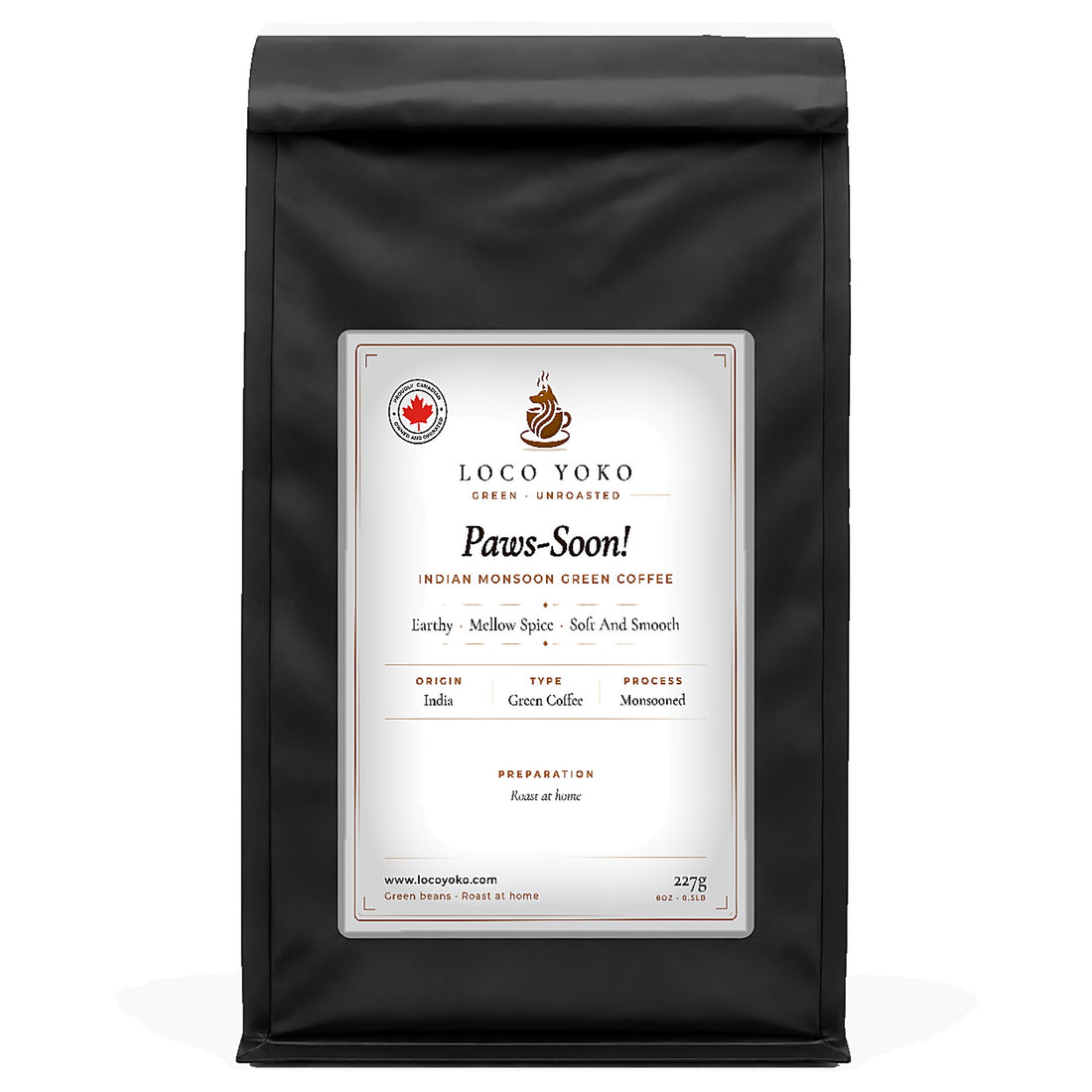


Paws-Soon! - Indian Monsoon Green Coffee
Green Coffee Beans | Roasted at Home by You | Brought to You by LocoYoko Coffee Some things get better with time — like trust, love, and a beautifully aged coffee. Paws-Soon! features Indian Monsoon Malabar green coffee beans, known for their rare processing method that relies on...
 2026 Canadian Choice Award
Proud winner
2026 Canadian Choice Award
Proud winner
Cupping notes: Earthy · Mellow spice · Soft and smooth. Single-origin from India. Roasted to order and stamped with its roast date — best enjoyed within 4 weeks.
We roast and ship Monday–Friday, usually within 24 hours. Free shipping Canada-wide on orders over $50; flat $6 under. Our 30-day happiness guarantee means we'll make it right.
Pour-over (V60): 1:16 ratio, 22 g coffee to 350 g water at 94 °C, ~2:45 total. Prefer filter or French press? Pick your grind above and we'll dial it in.
The spec sheet.
Every bag is stamped with the day it was roasted. If it's older than 30 days when it reaches you, we'll replace it free.
What Canadians say.
Write a review
Switched from the grocery-store stuff and never looked back. Loved discovering India. Fresh every time.
Gorgeous cup. Earthy on the nose, smooth all the way down. Feels premium without the airs.
I've reordered three times now. Smooth, balanced and the coffee I reach for every single morning.
Pairs well with.
What Makes Paws-Soon! a Monsooned Coffee From India
Paws-Soon! is our take on monsoon malabar coffee, one of the strangest and most distinctive processing methods in the coffee world. Most green coffee is dried down quickly after picking and shipped off within weeks. Monsoon processed coffee does the opposite: green beans are spread out in open-sided warehouses along India's Malabar coast and left exposed to the humid monsoon winds for weeks at a time, turned by hand every few days. The beans swell, pale from green to a warm straw-gold color, and pick up a completely different flavor than they'd have as a fresh crop. It's a process that only really works in that stretch of coastline, which is why true malabar coast coffee is still mostly grown and processed in the same region it's always come from.
This particular lot comes from growers in the hill regions behind the Malabar coast, where the crop is grown at moderate elevation under shade trees before making the trip down to the coastal warehouses for monsooning. Once there, the parchment-dried beans are laid out in shallow layers on raised platforms, exposed to the open air, and raked and turned by hand roughly every four days for as long as twelve to sixteen weeks, depending on how the season's humidity is running. The crew watches color and moisture closely — too little exposure and the beans never develop the signature pale, swollen look; too much and they can pick up mustiness that goes past "earthy" into genuinely off. It's a slow, hands-on process, and it's part of why monsooned malabar has always commanded a different price and reputation than standard Indian export coffee.
If you've gone looking for indian coffee beans canada shoppers can actually get their hands on, you'll know monsooned stock is rare outside specialty roasters — most of what reaches North America is generic commodity-grade robusta, not this style. Historically, monsooning wasn't even an intentional process; it started centuries ago when green coffee shipped from India to Europe by sailboat spent months at sea exposed to salt air and humidity, and traders noticed it arrived tasting mellower and less acidic than coffee that traveled quickly. Once steamships shortened the voyage, growers on the Malabar coast began recreating that effect on land deliberately, which is the method still used today. We roast this one to order here in Toronto and rest it 24-72 hours post-roast before it ships, same as everything else in our lineup, so the beans are settled and ready to brew by the time they land on your counter.
Flavor Profile: Earthy, Mellow, and Low in Acid
If you're searching for indian monsoon coffee beans because you've had monsooned malabar before and want that specific cup again, here's what to expect from this lot: it's earthy, low in acid, and heavier in body than most washed or natural coffees you've probably tried. The tasting notes we've settled on are earthy, mellow spice, and soft and smooth — and that's not marketing shorthand, it's genuinely what the process does to the bean. Monsooning breaks down a lot of the bean's original acidity and brightness, replacing it with a rounder, muted sweetness and notes that read more like cedar, wet soil, and warm baking spice than the citrus or berry notes you'd get from an East African coffee.
People often describe monsoon malabar coffee taste as "wild" or "musty" the first time they try it, and that's fair — it doesn't taste like typical specialty coffee. But muskiness isn't a flaw here, it's the point. Give it a chance and what comes through is closer to dark chocolate spice coffee beans, allspice, and a faint tobacco-leaf earthiness that lingers pleasantly rather than turning bitter. It's one of the more polarizing profiles we carry, but for people who already know they like low acid, earthy cups, this is about as authentic an example as you'll find outside India.
Who This Coffee Is For
This is a good match for anyone browsing our full coffee selection specifically hunting low acidity coffee beans because regular coffee bothers their stomach, or because they've simply decided brightness and acidity aren't what they're after in a morning cup. If you deal with acid reflux, are sensitive to caffeine's effect on an empty stomach, or you've been told to look for something described as low acid coffee for sensitive stomach reasons by a doctor or just your own gut, monsooned malabar is one of the gentlest styles you can drink. The monsoon process physically lowers the perceived acidity of the bean, so this isn't a case of a roast profile faking mildness — it's baked into the raw material before it ever hits our roaster.
It's also a great fit if you gravitate toward earthy coffee beans in general — think aged Sumatra, some darker Ethiopian naturals, or anything described as funky or soil-forward. If your usual order leans toward spicy earthy coffee beans with a heavier mouthfeel rather than the clean, tea-like cups from Kenya or Colombia, Paws-Soon! will feel instantly familiar. On the other hand, if you love bright, juicy, high-acid coffee, this one might read as flat to your palate — that's a matter of taste, not a defect in the beans.
Roast Level and Grind Recommendations
We roast this coffee to a medium-dark level, just past the point where the earthy, spice-forward character really opens up but before the roast itself starts dominating the cup. Push it darker and you lose some of the subtlety that makes monsooned malabar interesting in the first place; roast it too light and the beans can taste flat or grassy, since a lot of monsooned coffee's sweetness only develops with a bit more heat.
For grind size, match it to your brew method the way you would with any coffee:
- Drip or pour-over: medium grind, similar texture to coarse sand.
- French press or cold brew: coarse grind, closer to breadcrumbs, so it doesn't turn muddy or over-extract.
- Espresso: fine grind — this coffee's low acidity and heavy body actually make a really solid base for espresso blends or straight shots with minimal bitterness.
- Moka pot: medium-fine, between drip and espresso grind.
Because the beans go through an unusual pre-roast transformation, they tend to be a bit more porous than typical green coffee, so they can degas and stale slightly faster once ground. Grinding fresh right before brewing, rather than a whole week's worth at once, will keep that earthy spice character from fading.
Brewing Tips for a Smooth, Low-Acid Cup
If you want the smoothest, least acidic result, brew methods that use full immersion — French press, or a slow pour-over with a long bloom — tend to bring out the roundness in this coffee better than fast, high-pressure methods. Water temperature matters too: keep it around 195-200°F rather than boiling, since monsooned beans can turn slightly bitter if you scald them.
For anyone specifically chasing a smooth low acid coffee in the mornings, we'd suggest a 1:16 ratio (about 60g of coffee per litre of water) with a longer contact time than you'd use for a brighter coffee — an extra 30 seconds in a French press, for instance. That slower extraction pulls more of the sweetness and body forward without dragging along any harshness. Cold brew is another strong option here: the low acidity carries over beautifully into a cold format, and the earthy spice notes hold up well over a 12-18 hour steep.
How It Compares to Other Coffees We Carry
If monsoon processing is new to you, it helps to compare it against coffee that hasn't been through the process. Our Take a Paws - Indian Coffee is a good side-by-side: same country of origin, but conventionally processed, so it keeps more of its natural brightness and fruit-forward character instead of the deep, earthy spice you get here. Tasting the two back to back is honestly the easiest way to understand what monsooning actually does to a bean — same origin, two completely different cups.
If you're building out a broader sense of what indian coffee tasting notes can look like beyond this one lot, browsing our Indian coffee lineup is worth the time — it spans everything from brighter, more classic profiles to deeper, monsooned styles like this one. And if you're just getting oriented and want to browse everything we roast, not just the India-origin lots, our full coffee collection covers origins from South America, Africa, and Asia side by side, so you can see how a Malabar cup stacks up against something from Ethiopia or Colombia in the same lineup.
Buying Monsooned Beans in Canada
Finding real monsooned stock isn't always easy up here — a lot of what's labeled "Indian coffee" at grocery stores is blended, low-grade robusta with none of the character this process is known for. If you're specifically trying to buy monsoon malabar coffee canada wide, roasted properly and shipped fresh rather than sitting in a warehouse for months, that's exactly what we're set up to do. Every bag is roasted to order here in Toronto, rested the standard 24-72 hours before it ships, and sent out with free shipping across Canada on orders over $50.
For anyone who's been searching out monsooned malabar coffee online and mostly finding either imported bags of unknown age or big-brand blends that barely mention monsooning at all, we'd rather be upfront: this is a small-batch, single-origin lot, roasted in short runs so it doesn't sit around losing its character before it reaches you. If you've never tried monsoon processed coffee before, this is a solid, honest entry point into the style rather than a novelty version of it.
Storage and Freshness
Store your beans in an airtight container away from light and heat — a kitchen cupboard works better than a spot near the stove or a sunny window. Because monsooned beans are a bit more porous than standard green coffee, as mentioned above, they benefit even more than usual from being kept sealed. We'd recommend using this coffee within 4-6 weeks of the roast date for the best flavor, and always giving it that initial 24-72 hour rest window after roasting before your first brew — degassing evens out and the flavor is noticeably more balanced once the beans have had a couple of days to settle.
A vacuum-sealed canister or a bag with a one-way degassing valve will keep this coffee tasting fresh for longer than a simple clip-top bag, especially if you live somewhere humid in the summer months. Avoid the freezer unless you're portioning out beans you won't use for several weeks — repeated trips in and out of cold storage introduce condensation, and that moisture works against everything the monsooning process was trying to achieve in the first place. If you do freeze a portion, pull it out, let it come fully to room temperature unopened, and use it within a few days rather than refreezing what's left.
FAQ
What is monsoon malabar coffee, exactly?
It's coffee that's been intentionally exposed to humid monsoon winds along India's Malabar coast for several weeks after harvest, rather than being dried and shipped quickly like most green coffee. The beans absorb moisture, swell, and change color from green to pale gold, which lowers the acidity and develops a distinct earthy, spiced flavor you won't get from conventionally processed beans. It's a regional tradition unique to that part of southern India, and one of the few processing methods that actually depends on the local climate rather than a controlled facility.
Does monsoon processing actually lower acidity?
Yes. The extended moisture exposure physically changes the bean's chemistry, reducing the organic acids responsible for brightness in a typical cup of coffee. That's why monsooned malabar is one of the most reliable options if you're after genuinely low acid beans rather than just a darker roast, which only masks acidity rather than actually reducing it.
What does this style of coffee taste like?
Expect an earthy, mellow, low-acid cup with notes that lean toward cedar, baking spice, and dark chocolate, plus a heavier, syrupy body than most washed coffees. It's sometimes described as musky or wild on the first sip, which is normal for the style — it's a genuinely different profile from brighter, fruit-forward coffees.
What's the best way to brew this coffee?
Full-immersion methods like French press or a slow pour-over bring out the roundness and body best. Use water around 195-200°F, a roughly 1:16 coffee-to-water ratio, and a slightly longer brew time than you'd use for a brighter coffee. It also holds up very well as a cold brew or as part of an espresso blend.
How is this different from Take a Paws - Indian Coffee?
Both are grown in India, but Take a Paws is conventionally processed and keeps more natural brightness and fruit character, while Paws-Soon! goes through the monsooning process, trading that brightness for a deeper, earthier, lower-acid cup. Trying them side by side is the easiest way to taste what monsoon processing actually changes.
How long do the beans stay fresh after roasting?
We recommend using this coffee within 4-6 weeks of the roast date for the best flavor, and letting it rest 24-72 hours after roasting before your first brew. Store it in an airtight container out of direct light and heat, and grind just before brewing since monsooned beans can lose their character a little faster than standard green coffee once ground.
Frequently asked questions
The essentials about this coffee. Still curious about something?
Ask us anything