
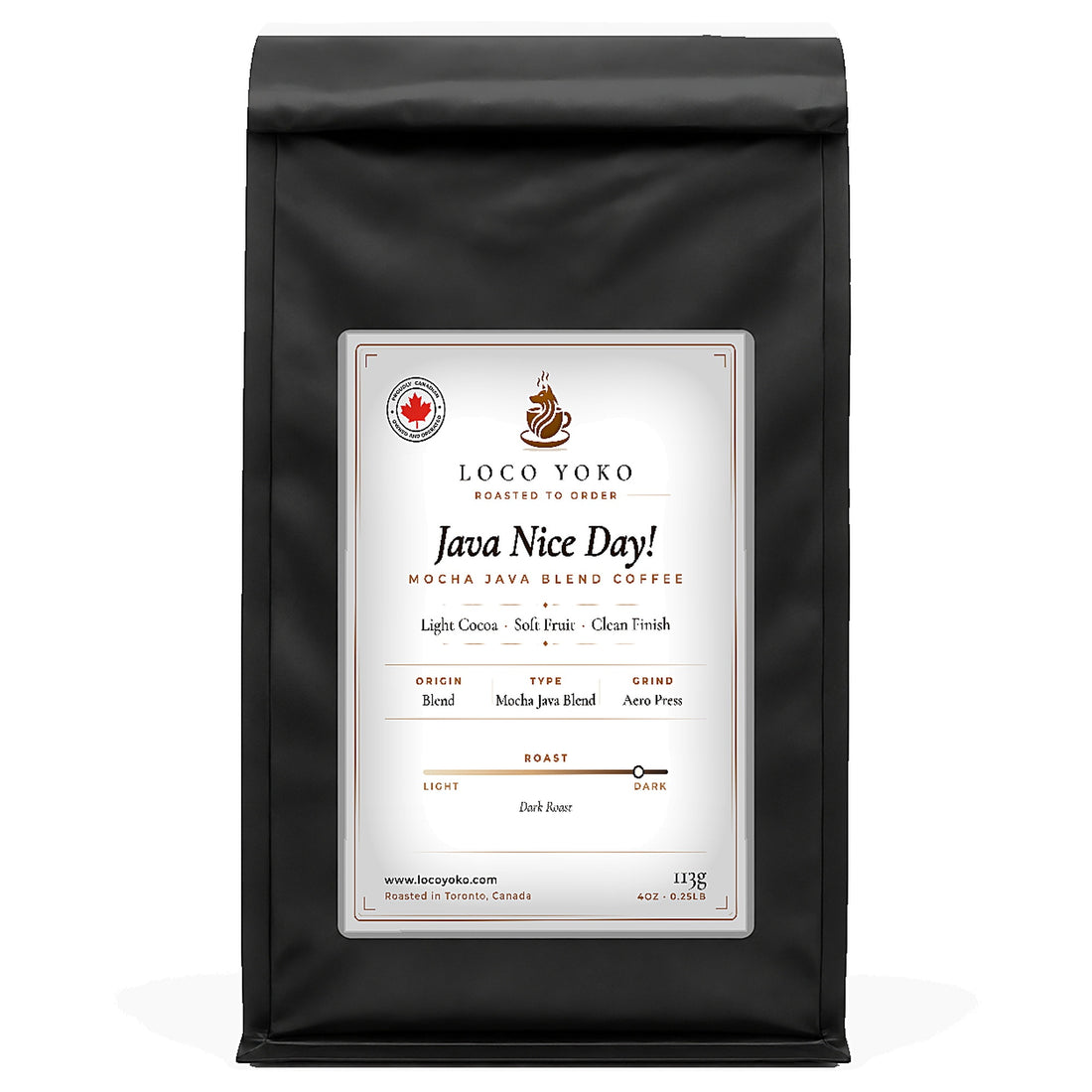


Java Nice Day! - Mocha Java Blend Coffee
Roasted & Packed in Canada | Brought to you by LocoYoko Coffee Every day’s a good day when it starts with the right brew — and the right buddy by your side. Java Nice Day! is a smooth, balanced blend of 100% Arabica beans inspired by the legendary...
 2026 Canadian Choice Award
Proud winner
2026 Canadian Choice Award
Proud winner
Cupping notes: Light cocoa · Soft fruit · Clean finish. Single-origin from Blend. Roasted to order and stamped with its roast date — best enjoyed within 4 weeks.
We roast and ship Monday–Friday, usually within 24 hours. Free shipping Canada-wide on orders over $50; flat $6 under. Our 30-day happiness guarantee means we'll make it right.
Pour-over (V60): 1:16 ratio, 22 g coffee to 350 g water at 94 °C, ~2:45 total. Prefer filter or French press? Pick your grind above and we'll dial it in.
The spec sheet.
Every bag is stamped with the day it was roasted. If it's older than 30 days when it reaches you, we'll replace it free.
What Canadians say.
Write a review
Switched from the grocery-store stuff and never looked back. Loved discovering Blend. Fresh every time.
Gorgeous cup. Light cocoa on the nose, smooth all the way down. Feels premium without the airs.
I've reordered three times now. Smooth, balanced and the coffee I reach for every single morning.
Pairs well with.
What Java Nice Day! Actually Is
Java Nice Day! is our take on one of the oldest coffee traditions there is: the Mocha Java blend. If you've ever wondered what is Mocha Java coffee exactly, the short answer is that it's a marriage of two very different beans from two very different corners of the coffee-growing world, blended together so each one covers for what the other lacks. Ours pairs a Yemen-style dry-processed lot for body and spice with an Indonesian-style wet-hulled lot for a low, earthy backbone, roasted here in Toronto in small batches and rested before it ever leaves our roastery.
The name isn't marketing flourish. "Mocha" refers to the old port city of Al Makha in Yemen, once the main trading hub for coffee leaving the Arabian peninsula, and "Java" is the Indonesian island where the Dutch first planted coffee outside of Africa and Arabia in the late 1600s. When traders started combining beans from both origins in the 1700s to balance flavor and manage supply, they created what's widely considered the world's oldest coffee blend still recognized by name today. Java Nice Day! is our modern homage to that pairing, built for people who want a cup with real history behind it, not just a cute name on the bag.
We treat this as a genuine two-origin pairing rather than an arbitrary house blend wearing a historic name. Each component is roasted and rested separately, then blended after roasting so we can taste and adjust the ratio batch to batch, since no two harvests behave identically going into the roaster.
Flavor Profile: Light Cocoa, Soft Fruit, Clean Finish
This is a mocha java blend coffee through and through, and the tasting notes tell you exactly what to expect: light cocoa, soft fruit, and a clean finish. The cocoa comes through first — not a heavy, syrupy chocolate note, but something closer to a good dark drinking chocolate, dry and a little bitter-sweet. That's followed by a gentle wave of soft fruit, more stone fruit or dried fig than anything bright or citrusy, which softens the edges of the cup. It finishes clean, without the lingering heaviness some earthy Indonesian coffees can have on their own.
If you're the kind of drinker who gravitates toward coffee with cocoa notes but finds single-origin chocolatey coffees a bit one-dimensional, this blend is worth a look. The fruit component keeps it from tipping into pure "coffee-flavored cocoa" territory, and the Java component underneath gives it a fuller body than a straight washed Yemeni coffee would have. We'd describe it as one of the more smooth chocolatey coffee beans in our current lineup — approachable, not sharp, and forgiving if your brew ratio is slightly off.
Where it sits relative to acidity: this is a low-acid cup by design. The wet-hulled processing typical of Java-style beans naturally suppresses brightness and pushes body and earthiness forward, and blending that against a naturally sweeter, more structured Yemen-style component keeps things balanced rather than flat. If you like your coffee sharp and citrus-forward, this isn't that. If you want something rounder that still has personality, keep reading, because the fruit note here isn't an afterthought — it's what separates this from a flat, one-note earthy cup.
One more thing worth naming: this coffee has a genuinely pleasant coffee beans with fruity finish quality that surprises people expecting a purely chocolate-forward cup. It shows up late, after the cocoa opens things up, more like the last note in a good dessert wine than an upfront citrus hit.
Who This Coffee Is For
Java Nice Day! tends to win over a few specific kinds of drinkers. First, anyone who default-orders a mocha at a cafe and wants that chocolate note built into the bean itself rather than added as syrup — this gives you a genuine base for that flavor without needing to doctor the cup. Second, people who find fully washed, high-acid coffees from Kenya or Ethiopia too sharp for daily drinking but still want more character than a flat "breakfast blend." Third, French press and moka pot drinkers, because the body and low acidity of this blend hold up beautifully in full-immersion brewing.
It's also a solid entry point if you're newer to trying arabica coffee blend Canada options beyond the basic pre-ground bags at the grocery store. Because it's balanced rather than showcasing one loud flavor note, it's forgiving of grind inconsistency and brew-time variation, which makes it a good "everyday" bag rather than a coffee you have to baby. It also plays well at the table — the cocoa and soft fruit notes hold up next to pastries, dark chocolate, or a weekend breakfast spread without fighting the food.
Roast Level and Grind Guidance
We roast this as a medium roast, which is the right call for a blend built around cocoa and soft fruit rather than bright acidity. Push a Mocha Java blend into dark roast territory and you lose the fruit note entirely, leaving mostly bitterness and char. Keep it too light and the Java component's earthiness can taste underdeveloped and a little vegetal. Medium roast lets both halves of the blend do their job: enough development to round out the acidity and pull the cocoa forward, not so much that you're just tasting carbon.
If you're specifically hunting for medium roast coffee beans Canada wide, this is a good one to keep in rotation, especially if you tend to burn through darker roasts faster because they go stale-tasting sooner. Medium roasts like this one hold their flavor a bit longer post-roast, provided you're storing them properly — airtight, away from light and heat, and ideally not in the fridge or freezer once opened, since condensation is the enemy here.
On grind: we sell it as whole bean by default, and we'd encourage you to grind fresh right before brewing if you can. Buying whole bean and grinding to order is one of the simplest upgrades you can make if you're used to pre-ground bags — the aromatic oils that carry a lot of this blend's cocoa and fruit character start degrading within minutes of grinding, not days. If you're comparing options to buy whole bean coffee online Canada wide, going whole bean and grinding per-brew is the single change that will make the biggest difference in your cup, more than switching origins or roast levels. A basic burr grinder will outperform even the freshest pre-ground bag within a week of purchase.
Brewing Recommendations
Because of its body and low acidity, this is one of the better coffees in our lineup for full-immersion methods. For French press, we'd call it genuinely one of the best coffee blend for French press options we carry — the metal filter lets the natural oils through, which amplifies the chocolate note and gives you a heavier, more textured cup. Use a coarse, even grind (think coarse sea salt), a 1:15 coffee-to-water ratio, and a four-minute steep. Skimming the crema-like layer off the top before you press down helps avoid over-extraction bitterness, and letting the grounds settle for thirty seconds before your final pour keeps sediment out of the cup.
Moka pot works well here too, for the same reason — it's a pressure-brewed, full-body method that suits a coffee that isn't relying on delicate acidity to shine. Fill the basket level without tamping, use water just off the boil in the base chamber, and pull it off the heat the moment you hear the hissing gurgle that signals the water's run through, so you don't scorch the last of it.
If you prefer pour-over, this blend still works, but expect a rounder, less "juicy" cup than you'd get from a washed single origin; use a slightly finer grind than you would for French press and keep your water just off the boil, around 92-94°C, to avoid over-extracting the cocoa notes into bitterness. A 1:16 ratio with a slow, steady pour in two or three stages tends to bring out the fruit note without letting the earthiness dominate.
Drip machines and AeroPress both handle this blend fine as well. For AeroPress, a shorter steep (60-90 seconds) with an inverted method tends to bring out the fruit note a little more, while a standard upright method leans into the cocoa and body. Either way, give the beans their full 24-72 hour post-roast rest before brewing — like every coffee we roast, this one is roasted to order and ships fresh, and that rest window lets the CO2 released during roasting settle down so you get a cleaner extraction instead of excess bloom and uneven flavor. Skipping the rest period is the single most common reason a fresh bag tastes flat or overly foamy in the first day or two.
How It Compares to Our Other Yemen-Java Pairings
If Java Nice Day! catches your interest, it's worth knowing it's not the only pairing of this kind we roast. We keep a small dedicated shelf of Mocha Java-style blends where you can compare a few different ratios and roast approaches side by side if you want to taste how the balance between the two origins shifts the cup. Some lean more toward the Yemen-style component for a spicier, winier edge; this one leans toward balance, with cocoa and soft fruit sitting at the front.
We also roast a dedicated espresso version of this same origin pairing, Loco-Mocha, which is roasted darker and blended slightly differently to hold up under pressure brewing and cut through milk. If you've tried Java Nice Day! as drip or French press and loved the chocolate note, Loco-Mocha is the natural next stop for anyone pulling shots or making milk drinks at home — same origin DNA, different job.
And if you're still exploring more broadly, our full coffee lineup spans single origins, other blends, and different roast levels, so you can see where this one sits relative to everything else we roast. We'd position Java Nice Day! as a solid middle ground: more character and history than a generic house blend, more approachable and food-friendly than a bright single-origin natural.
Sourcing and Why We Blend This Way
A lot of what gets sold as mocha java coffee beans on the market today is really just a marketing label slapped on an arbitrary two-origin blend. We take the pairing more literally. The Yemen-style component in this blend is sourced from small-lot dry-processed coffee grown at high altitude, typically 1,500 to 2,200 metres, on terraced mountainside plots — a growing method that hasn't changed much in centuries because the terrain doesn't really allow for modern mechanization. Dry, or natural, processing means the cherries are laid out to dry with the fruit still on the seed, which is what gives Yemen-style coffee its dense, almost wine-like sweetness and spice.
The Java-style half is wet-hulled, a processing method mostly unique to Indonesia where the parchment is removed from the bean while it still has higher moisture content than standard washed processing. That's what gives Indonesian-style coffee its heavier body, lower acidity, and that distinctive earthy, almost herbal quality — the exact quality that, in the right proportion, rounds out and deepens the brighter, spicier Yemen component instead of fighting it.
Blending these two well is less about a fixed recipe and more about tasting each new lot as it arrives and adjusting the ratio to hit the same cocoa-forward, soft-fruit profile every time, since natural agricultural variation means no two harvests taste identical. That's also why we roast the components of this Yemen Java coffee blend in small batches rather than pre-blending green coffee in bulk — roasting each origin separately and blending post-roast gives us more control over hitting the same cup profile bag to bag, even as the underlying green coffee shifts season to season. It also means we can hold back a component that's tasting off in a given week rather than shipping a blend that's out of balance.
Both origins also carry real logistical weight. Yemen coffee production has been squeezed for years by conflict and limited infrastructure, which keeps volumes small and prices high relative to most other origins — part of why true Mocha Java has always been a bit of a specialty item rather than a commodity blend. Java-grown coffee, by contrast, benefits from Indonesia's long-established wet-hulling infrastructure, built up over generations specifically around this processing style, which is part of why Indonesian-style earthiness is so consistent origin to origin even as individual farms change hands.
Why Buy Mocha Java Coffee From Us
If you're trying to buy Mocha Java coffee Canada wide and want it fresh rather than sitting in a warehouse for months, everything we roast — this blend included — goes out to order. We roast in Toronto, rest every batch 24-72 hours before shipping to let the coffee de-gas properly, and ship free anywhere in Canada on orders over $50. You're not buying off a shelf that's been sitting since some unknown roast date; you're buying a bag roasted specifically for your order, which matters more for a blend like this one where the balance between the two components is the whole point — stale coffee flattens exactly the contrast that makes a Mocha Java blend worth drinking in the first place.
We also don't hide our tasting notes behind vague marketing language. Light cocoa, soft fruit, clean finish is what you'll actually taste, not an aspirational description written to sound nice on a bag. If a batch tastes different enough from that description to matter, we'd rather adjust the blend ratio on the next roast than keep shipping something that doesn't match what we're telling you to expect. That's also why we'd rather you taste this alongside the rest of our Yemen-Java pairings and decide which ratio suits your palate, instead of assuming one blend fits everyone.
FAQ
What makes this a Mocha Java blend coffee?
It's a blend of beans from Yemen (or Yemen-style dry-processed coffee) and the Indonesian island of Java. The pairing dates back to 18th-century coffee trade routes and is generally regarded as the world's oldest known coffee blend still made today. The Yemen component contributes spice, sweetness, and body; the Java component contributes low acidity, earthiness, and a heavier mouthfeel. Together they typically produce a cup with chocolate or cocoa notes, soft fruit, and a rounder, less acidic profile than either origin would have alone — the reason so many people searching for chocolate coffee beans Canada wide end up trying a blend like this one.
What does Java Nice Day! taste like compared to a regular medium roast?
Compared to a generic medium roast blend, Java Nice Day! has more defined character: a clear light cocoa note up front, a soft, almost dried-fruit sweetness in the middle, and a clean, non-bitter finish. Generic medium roasts are often blended for neutrality; this one is blended specifically to showcase the contrast and balance between its two origins, so it reads as more distinct and food-friendly, particularly alongside pastries, dark chocolate, or breakfast dishes.
Is this a good coffee for beginners?
Yes. Its low acidity and forgiving body make it tolerant of small brewing mistakes — slightly off ratios or brew times won't wreck the cup the way they might with a delicate washed single origin. It's also a good starting point if you're trying to figure out your preferences among different arabica blends, since it sits in a comfortable middle ground between bright and heavy, and it's hard to genuinely mess up with a basic drip machine or French press.
What's the best brew method for this blend?
French press and moka pot bring out the best in it, since both are full-immersion or pressure methods that emphasize body and let natural oils through, amplifying the cocoa notes. Pour-over and drip both work fine too, just expect a slightly less rich, more tea-like cup than you'd get from immersion brewing. AeroPress splits the difference and lets you nudge the flavor toward fruit or cocoa depending on steep time and orientation.
How is this different from Loco-Mocha?
They share the same Yemen-Java origin pairing, but Java Nice Day! is roasted and blended for filter methods like drip, pour-over, and French press, with a medium roast that preserves the fruit note. Loco-Mocha is roasted darker and calibrated for espresso, where higher pressure and shorter contact time need a slightly heavier hand to extract properly and to cut through milk in lattes or cappuccinos.
Should I buy whole bean or ground?
We recommend whole bean if you have any kind of grinder at home, even a basic one. Ground coffee starts losing aroma and flavor within days, while whole bean holds its character for weeks when stored properly in an airtight container away from heat and light. Grinding fresh right before brewing is especially worth it for a blend like this one, where the cocoa and soft fruit notes are the entire point of the coffee.
Frequently asked questions
The essentials about this coffee. Still curious about something?
Ask us anything