
Kona Blend Coffee
Kona Blend Coffee — layered for balance and consistency, roasted to order in Canada and shipped free over $50.
Products in this collection
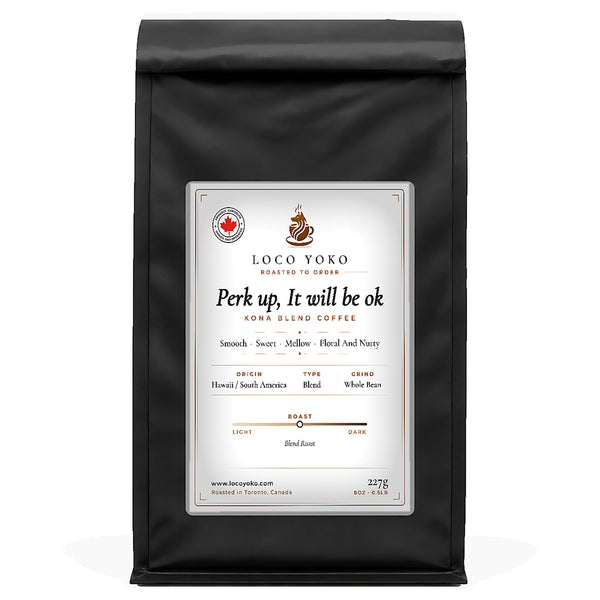
Perk up, It will be ok
Subtle spice · Nutty · Bright & earthy
Try removing a filter or two.
Tap a choice and we'll take you to the next step.
What Kona Blend Coffee Actually Is
The name "Kona" refers to a narrow strip of volcanic slope on the Big Island of Hawaii, roughly two miles wide and thirty miles long, running along the Kona Districts of Hualalai and Mauna Loa. It's one of the only places in the United States where coffee is grown commercially, and the microclimate there — morning sun, afternoon cloud cover, mineral-rich volcanic soil, and mild trade winds — produces a genuinely distinctive cup. Kona blend coffee takes beans grown in that region and combines them with beans sourced from other origins, most often Central or South America, to create a more affordable, more widely available product that still carries real Kona character. It's a different animal from a straight single-origin bag, and understanding how it's built helps explain both its price and its flavor.
Under U.S. federal trade law, any bag labeled this way must contain at least 10% actual Kona-grown beans, with the remainder disclosed as coming from elsewhere. That's a legal minimum, not a target, and it's worth knowing because it explains why quality varies so much between brands sold under the same general name. A blend built at 10% Kona and 90% generic filler coffee is a very different product from one built at 30-40% Kona with high-quality supporting lots. When we build ours, we lean toward the higher end of that range specifically because the whole point of buying kona coffee beans in the first place is to actually taste Kona, not just see the word on the label. Shoppers hunting for the best kona coffee brands canada has to offer should treat that percentage as the single most important number on the bag, well above roast date or origin story marketing.
Kona Coffee Beans: Growing Region and Processing
Kona's coffee farms sit at elevations between 500 and 3,000 feet on the western flank of two volcanoes, which matters more than it sounds. Higher elevation slows down cherry maturation, giving the bean more time to develop sugars and acidity before harvest. Most Kona farms are small, family-run operations of a few acres each, hand-picking ripe cherries in multiple passes through the season rather than stripping the branch all at once — a labor-intensive approach that keeps out underripe or overripe fruit and is a big part of why hawaiian kona coffee beans command a premium over mass-harvested lots elsewhere in the world.
The dominant processing method in Kona is washed (wet) processing: cherries are pulped, fermented in tanks to break down the mucilage, washed clean, then dried — usually on raised beds or patios under the Hawaiian sun. Washed processing tends to produce a cleaner, brighter cup with the fruit character coming through as acidity rather than heavy body, which is part of why coffee described as authentic kona coffee canada roasters and retailers talk about tends to read as "clean" rather than "wild" or "funky" the way some natural-processed African coffees do. A smaller number of Kona farms also experiment with honey or natural processing, leaving some or all of the fruit pulp on during drying for a heavier, sweeter cup, though washed remains the industry standard for the region and the style most buyers expect when they picture Kona.
Kona Coffee Taste Notes: What to Expect in the Cup
Real Kona character shows up as a specific, recognizable set of kona coffee tasting notes chocolate caramel drinkers tend to describe consistently: mild, well-rounded body, low-to-moderate acidity that reads as bright rather than sharp, and a smooth, nutty-sweet finish with cocoa and brown sugar undertones. There's typically little to no bitterness even at darker roasts, and none of the wine-like or fermented fruit notes you'd get from a natural-processed Ethiopian or a fully washed Kenyan lot. It's an easy-drinking, food-friendly cup rather than a showy, high-acid one.
In a blend, that character gets diluted but not erased — the supporting beans (often Central American in origin) tend to be selected for a compatible flavor profile: similarly smooth, similarly low on aggressive acidity, so the two components merge rather than fight each other in the cup. A well-built blend should still finish with that characteristic mellow sweetness even if the front-of-palate brightness is a bit softer than a straight Kona would deliver. This is also where kona coffee taste notes start to diverge noticeably between brands — a blend built on cheap filler coffee will taste thin and generic, while one built on well-chosen supporting lots will still read as recognizably Kona-adjacent even at a lower percentage. If you're curious how deliberate blending changes a cup, our blended roasts collection is a good place to taste the effect across a few different combinations before deciding whether blended or single-origin fits your morning routine better.
100% Kona Coffee vs Kona Blend: What's the Real Difference
The 100 kona coffee vs kona blend question comes down to intensity and price. A 100% Kona coffee delivers the full expression of that terroir — more pronounced sweetness, a fuller sense of the volcanic-soil minerality, and a noticeably higher price tag, since true Kona farmland is limited and yields are small relative to global demand. A kona blend vs 100 percent kona comparison isn't really "better vs worse" so much as "concentrated vs accessible." The blend gives you a recognizable slice of that flavor profile — the chocolate-caramel sweetness, the mellow body — at a fraction of the cost, because most of the volume comes from other, less scarce origins.
If you've never tried Kona before, a blend is a reasonable, budget-friendly way to get acquainted with the flavor before committing to a pricier 100% bag. If you already know you love that profile and want the full, undiluted version, you'll want to look specifically for bags labeled "100% Kona," since anything without that exact wording is legally required to be a blend. Buyers researching buy kona coffee online canada options often land on this exact fork in the road — pay more for the concentrated single-origin experience, or get a taste of the region at a friendlier price point while the rest of the bag is filled out with complementary origins.
Price Per Pound and What Drives It
Kona blend coffee price per pound sits well below 100% Kona pricing precisely because of that dilution — you're paying a premium for a smaller percentage of expensive, low-yield Hawaiian beans mixed with more readily available origins. Expect blend pricing to land in a moderate mid-range bracket compared to standard single-origin coffee, while true 100% Kona routinely runs several times higher per pound. When you're comparing best kona coffee brands canada shoppers can choose from, price is actually a decent proxy for Kona percentage — if a "Kona blend" is priced suspiciously close to a basic commodity coffee, it's worth asking what percentage of actual Kona is in the bag, since 10% minimums exist for a reason.
We roast to order out of our Toronto facility rather than holding large pre-roasted inventory, which keeps costs reasonable without cutting into the actual Kona content — you're paying for genuine sourcing and freshness, not for warehouse markup. If price is the deciding factor for you, it's worth browsing what else we roast on our main coffee page before you commit, since some of our other origins land in a similar price bracket with a different but equally distinct flavor profile.
Roast Level Guidance
Kona coffee medium roast is the level most roasters — us included — recommend for this origin, and there's a real reason for it beyond convention. Kona's natural sweetness and low acidity mean it doesn't need a dark roast to tame sharpness the way a brighter Central African coffee might. Pushing it dark burns off the delicate caramel and cocoa notes that make Kona worth seeking out in the first place, leaving mostly roast char flavor behind. A medium roast preserves the bean's own sugars while still developing enough body for drip, pour-over, or a standard drip machine. If you want something bolder for espresso, a medium-dark roast is the furthest we'd suggest pushing it before you start losing what makes Kona distinct.
Whole Bean or Ground
Kona coffee ground or whole bean is really a freshness question. Whole bean holds its aromatic oils and CO2 far longer than pre-ground coffee, which starts losing volatile compounds within minutes of grinding. Since Kona's appeal is largely about those delicate chocolate-caramel and low-acid nuances, grinding it fresh right before brewing preserves far more of what you paid for. We sell kona coffee whole bean by default for exactly this reason, though we grind to order on request if you don't have a grinder at home. As with all our roasts, we recommend a 24-72 hour rest period after roasting before you brew, letting the beans degas properly so the coffee doesn't taste flat or overly sharp straight off the roaster.
How This Blend Compares to Other Origins We Carry
If you're used to shopping by origin, it helps to place Kona in context against the rest of our lineup. Compared to a bright, floral Ethiopian or a winey natural-processed lot, this style reads as noticeably calmer and rounder — less acidity up front, more of a steady, sweet finish. Compared to a typical Colombian or Brazilian single origin, it's fairly similar in body but tends to edge out those origins slightly on smoothness and nutty sweetness, since Kona's volcanic soil and slow ripening give it a distinct minerality those other regions don't replicate. If straightforward, low-acid, everyday-drinking coffee is what you're after, our broader coffee lineup has several origins with a similar easy-drinking profile if Kona ever sells out or you want to compare side by side.
For shoppers who like the idea of blended profiles generally — beans selected specifically to complement each other rather than showcase one single farm — it's worth browsing our full lineup of coffee blends, since Kona blend is one approach among several we roast, each built around a different flavor goal.
Sourcing and Authenticity
Because "Kona" carries real market value, mislabeling has historically been a problem in the industry, which is exactly why the disclosure rules around blend percentages exist. When you're trying to find authentic kona coffee canada options, look for roasters who are transparent about where their Kona-origin beans actually come from and what percentage is in the bag — vague "Hawaiian-inspired" language without a stated percentage is usually a sign the Kona content is minimal or nonexistent. We buy directly from importers who deal with actual Kona District farms and roast the blend fresh in Toronto rather than buying a pre-blended bulk product from an unnamed supplier, which is the kind of sourcing transparency worth asking about no matter which brand you eventually buy from.
All of our coffee, Kona blend included, ships free across Canada on orders over $50, and every bag is roasted to order rather than pulled from long-sitting warehouse stock, so what you're tasting is a genuinely fresh interpretation of this origin rather than a bag that's been sitting in a distribution center for months.
FAQ
Is a Kona blend real Kona coffee?
Yes, but only partially. By law, any bag labeled this way must contain a minimum of 10% actual Kona-grown beans, with the rest coming from other disclosed origins. It's genuine Kona in part, blended with other coffees to bring the price down and the availability up.
What does Kona coffee taste like compared to regular coffee?
Kona coffee tasting notes chocolate caramel show up most consistently — a smooth, low-acid cup with a nutty, cocoa-forward finish and very little bitterness, even in darker roasts. It's rounder and gentler than high-acid coffees like Kenyan or Ethiopian, and sweeter and less sharp than most standard commercial blends.
Should I buy 100% Kona or a Kona blend?
If budget is a factor or you're trying Kona for the first time, a blend is a smart, accessible entry point that still delivers real Kona character. If you already love the profile and want the fullest, most concentrated expression of it, 100% Kona is worth the higher price per pound — just confirm the bag is explicitly labeled 100% Kona, since anything else is a blend by definition.
What roast level works best for Kona coffee?
Medium roast is the standard recommendation, and for good reason — it lets Kona's natural sweetness and low acidity shine without burning off the caramel and cocoa notes that make the origin distinct. A medium-dark roast works if you want more body for espresso, but going darker than that tends to mask what you're paying for.
Should I buy Kona coffee whole bean or pre-ground?
Whole bean is the better choice whenever possible. Kona's flavor depends on delicate aromatic compounds that degrade quickly once ground, so grinding fresh right before brewing preserves far more of the sweetness and nuance. We sell it whole bean by default and grind to order if needed.
How much does this blend cost compared to other coffees?
Price per pound for this style typically sits in a moderate range — higher than a basic commodity coffee, but well below true 100% Kona, which can run several times more per pound due to limited Hawaiian farmland and low yields. The exact price is a reasonable indicator of how much real Kona is actually in the bag, so shoppers weighing a kona blend coffee canada purchase against a pricier single-origin option can use cost as a rough sourcing signal.
Frequently asked questions
The essentials about this collection. Still curious about something?
Ask us anything